

Table of Contents
- The Best Sleeping Position for Back Pain
- Pillow Placement for Back Pain: Where Each Pillow Goes
- A Step-by-Step Bedtime Setup for Chronic Back Pain
- Nighttime Back Pain Relief: What to Do When Sleep Won’t Come
- Mattress and Pillow Selection for Real Spinal Support
- Morning Lower Back Pain: What to Do When You Wake Up Sore
- When to Get Chronic Back Pain Checked in San Antonio
- Frequently Asked Questions
Last Updated: October 21, 2026
The Best Sleeping Position for Back Pain
Chronic back pain is pain that lingers for 12 weeks or longer, and it can turn every night into a battle for rest. The fix starts with your sleeping position. (Source: according to the National Institute of Neurological Disorders and Stroke)
The best sleeping position for back pain is one that keeps your spine in a neutral line and takes pressure off your lower back.
Two positions do most of the work. Here is how each one sets up.
Sleeping on Your Back With a Pillow Under the Knees
Back sleeping is the easiest position to keep your spine neutral. The catch is that a flat mattress lets your lower back sag.
Slide a pillow under your knees. This slight bend in the hips flattens the lower back against the mattress and eases muscle tension. Add a thin pillow under your head for neck support, but keep it low so your chin does not tuck toward your chest.
Side Sleeping With a Pillow Between the Knees
Side sleeping works well for many people with back pain, as long as the hips stay stacked. When one leg drops forward, it twists the lower spine and pulls on the back muscles.
Place a pillow between your knees to keep the hips level. Choose a supportive pillow that fills the gap between your ear and shoulder so your neck stays in line with your spine.
Why Stomach Sleeping Worsens Chronic Back Pain
Stomach sleeping is the position we steer people away from most often. Lying on your stomach arches the lower back and compresses the spine, and you have to turn your head to breathe, which strains the neck.
If you cannot sleep any other way, put a thin pillow under your hips to reduce the arch. It is a patch, not a cure.
Pillow Placement for Back Pain: Where Each Pillow Goes
Pillow placement for back pain matters as much as the position itself. The right pillow in the wrong spot does little. Here is where each one goes:
- Under the head: a thin, supportive pillow that keeps your neck in line with your spine
- Under the knees (back sleepers): a standard pillow to flatten the lower back
- Between the knees (side sleepers): a firm pillow to keep hips stacked
One rule holds across all of them: support the natural curve of the lower back without forcing it. If a pillow feels like it is pushing your spine out of line, it is too thick.
A Step-by-Step Bedtime Setup for Chronic Back Pain
Most sleep-position advice stops at “put a pillow under your knees.” The part that actually helps is the sequence: how to arrange the support, get into position without twisting, and adjust once you are down.
Work through it in this order:
- Set the room first. Dim the lights, cool the room, and silence your phone. A dark, quiet, cool bedroom is the baseline for falling asleep with pain.
- Warm the muscles, not the mattress. Ten to fifteen minutes of heat on the lower back before bed relaxes tight muscles. Keep the heat pack off the skin and remove it before you lie down.
- Do two or three gentle stretches. A slow knee-to-chest stretch and a gentle cat-cow loosen the lower back. Move slowly and stop if anything sharpens.
- Build the pillow stack before you get in. Place the pillows where they need to be while you are standing, so you are not twisting to arrange them once you are lying down.
- Get in without twisting. Sit on the edge of the bed, lower your side toward the mattress, and bring your legs up together. Do not rotate your torso to swing your legs in.
- Settle into your position and check the line. For back sleeping, the pillow under the knees should flatten the lower back; for side sleeping, the pillow between the knees should keep the hips stacked and the head pillow should fill the ear-to-shoulder gap.
- Breathe slowly for a few minutes. Slow breathing lowers muscle tension and gives the setup time to work before you judge whether it is comfortable.
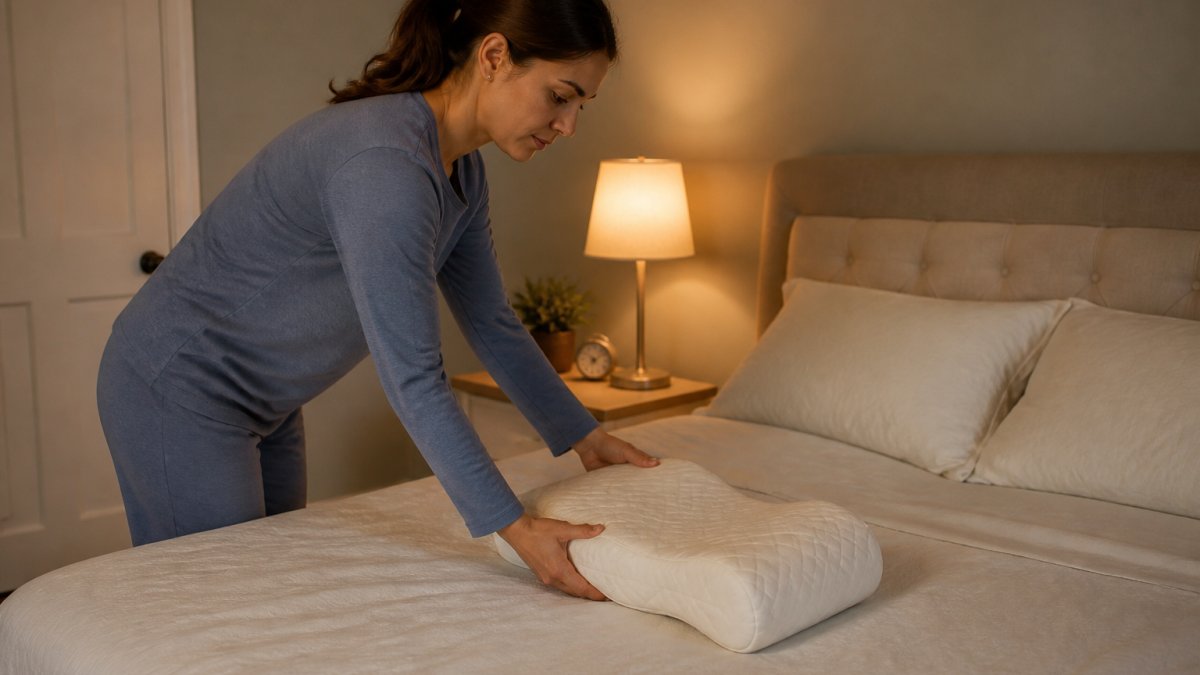
Set your pillows up before you get into bed, not after. Fussing with placement once you are lying down wakes you up and adds strain while you twist to adjust.
A setup that works on night one may need small changes as your pain shifts. If the lower back feels unsupported, add a thin pillow behind the waist for side sleeping or check that the knee pillow has not slid out of place. The goal is a repeatable arrangement you can rebuild in under a minute, so your body learns the position and your mind stops negotiating with the pillows at 2 a.m.
Nighttime Back Pain Relief: What to Do When Sleep Won’t Come
Nighttime back pain relief starts with calming the muscles, not forcing sleep. If you are lying awake, get up rather than tossing for an hour.
Try these in order:
- Heat therapy: a warm pack on the lower back for 15 to 20 minutes
- Cold therapy: an ice pack if the area feels hot or swollen
- Gentle stretching: slow, easy movements to release muscle tension
- Deep breathing: slow breaths to settle your nervous system
Sleep disruption and chronic pain feed each other. Poor sleep makes pain feel worse, and pain makes sleep harder. Keeping a steady bedtime routine, limiting screens before bed, and avoiding caffeine late in the day all help break that cycle.
Mattress and Pillow Selection for Real Spinal Support
No sleep position can rescue a mattress or pillow that fights your spine. The problem is that “medium-firm” and “supportive” mean different things to different bodies, so the useful approach is to judge support by criteria you can check in the store and at home, not by a label.
Mattress criteria to check:
- Spine stays level. Lie on your back and on your side in the position you actually sleep in. Your spine should stay in a neutral line, not sag at the waist or bow upward.
- Pressure points are cushioned. Your shoulders and hips should not feel pinched on your side. If they do, the surface is too firm for your body.
- No sagging dip. A visible dip or a surface that gives way under your hips pulls the lower back out of line. A mattress older than about eight to ten years is a common hidden cause of morning lower back pain.
- Edge support holds. If you sit on the edge to get in and out, a collapsing edge adds strain to the lower back.
Pillow criteria to check:
- Loft matches your position. Back sleepers generally need a lower pillow; side sleepers need a higher one that fills the ear-to-shoulder gap.
- It holds its shape. A pillow that flattens by morning stops supporting the neck. Check it after a few nights, not just in the store.
- It fills the gap without forcing. The pillow should support the natural curve of the lower back without pushing the spine out of line. If it feels like it is forcing your spine, it is too thick.
Trial periods and returns. Many mattresses sold in the United States come with a trial period, often around 90 to 100 nights, and most require a break-in period of a few weeks before the surface settles.
Do not buy a pillow or mattress based on firmness claims alone. Lie on it in the position you actually sleep in, and check the return policy before you commit.
If you wake sore in the same spot every morning, change one variable at a time: first the pillow, then the mattress topper, then the mattress. That order keeps you from spending on a new bed when a different pillow would have fixed the problem.
Morning Lower Back Pain: What to Do When You Wake Up Sore
Morning lower back pain is common with chronic pain, and how you get out of bed matters. Move slowly and protect your spine.
Try this:
- Roll onto your side and bend your knees.
- Swing your legs over the edge while you push up with your arms.
- Sit on the edge for a moment before standing.
- Do a few gentle stretches before you start your day.
If you wake sore most mornings, look at your setup the night before. A pillow that slipped out of place or a mattress that sags will show up as morning stiffness. A short walk and gentle movement often ease the stiffness faster than lying still.
When to Get Chronic Back Pain Checked in San Antonio
Most back pain settles with better sleep posture and home care. Some signs mean it is time to get checked by a professional.
See a doctor or chiropractor if you notice:
- Pain that lasts more than a few weeks despite home care
- Numbness, tingling, or weakness in your legs
- Pain that wakes you night after night
- Pain after a fall or car accident
At Moore Chiropractic, we offer a complimentary evaluation and consultation for new patients. We use gentle chiropractic techniques and build personalized care plans. If chiropractic is not right for your situation, we will tell you. Our goal is long-term relief, not a quick fix.
Better sleep with chronic back pain comes down to three things: a neutral spine, the right pillow placement, and a mattress that supports you. Get those right, and the rest of your routine has room to work.
Frequently Asked Questions
What is the best sleeping position for chronic back pain?
Back sleeping with a pillow under the knees is often the most supportive choice for chronic back pain. It keeps the spine in a neutral position and helps preserve the natural curve of the lower back while reducing pressure on the spine. Side sleeping with a pillow between the knees is a close second and works well for people who snore or have reflux. Stomach sleeping is the least supportive because it flattens the lower back’s curve and twists the neck. Try each position for a few nights and note which one leaves you stiffest in the morning.
Where should I put a pillow when sleeping with back pain?
Pillow placement depends on your position. On your back, place one pillow under the knees and a thinner one under the head to keep the neck aligned with the spine. On your side, put a pillow between the knees to stop the top leg from dropping and rotating the pelvis, plus one at chest height to keep the upper arm supported. A small rolled towel in the lower back’s curve can add lumbar support. Avoid stacking pillows under the head, which pushes the neck forward and can create neck pain on top of back pain.
Why does my back hurt more when I lie down at night?
Lying down removes the muscular support that keeps you upright during the day, so the spine and surrounding back muscles take the load differently. A mattress that sags or is too firm can let the lower back lose its natural curve, and inactivity allows muscle tension and stiffness to build. Nighttime back pain is also common in chronic pain conditions where the nervous system stays sensitized. If pain consistently worsens when you lie down, mention it at your next visit so a clinician can rule out causes that need specific care.
When should nighttime back pain be checked by a health care professional?
See a clinician if nighttime back pain keeps waking you for more than a couple of weeks, comes with numbness, weakness, or tingling in the legs, or is paired with fever, unexplained weight loss, or loss of bladder or bowel control. Those last symptoms need urgent care. Persistent pain that disrupts sleep and leaves you stiff every morning is also worth evaluating, because poor sleep and chronic back pain tend to reinforce each other. A chiropractor or physician can assess whether your sleep setup, posture, or an underlying condition is driving the problem.
Chronic back pain does not have to cost you your sleep. If home adjustments are not enough, our team at Moore Chiropractic can help. We offer gentle chiropractic techniques, personalized care plans, and a complimentary evaluation and consultation to find what is driving your pain. Contact us to schedule your visit and start sleeping better.