Table of Contents
- How Chiropractic Care Works for Sports Pain
- How Acupuncture Works for Sports Pain
- Key Differences Between Chiropractic and Acupuncture
- Benefits of Chiropractic for Athletes
- Recovery Time for Sports Injuries: What to Expect
- Integrative Pain Management for Athletes
- Frequently Asked Questions
Last Updated: September 10, 2026
How Chiropractic Care Works for Sports Pain
Chiropractic vs acupuncture for sports pain comes down to two different mechanisms: one restores mechanical alignment, the other modulates pain signaling. At Moore Chiropractic, we help patients understand the differences between these approaches before they commit to a treatment plan.
Chiropractic care is a hands-on, drug-free approach that focuses on the relationship between spinal alignment and how the nervous system functions. When an athlete takes a hard hit, plants a foot wrong, or repeats the same motion thousands of times, vertebrae and joints can lose their normal position and range of motion. That mechanical misalignment irritates nearby nerves, tightens soft tissue, and changes how the body recruits muscle.
A chiropractor locates those restrictions and corrects them with a spinal adjustment, a controlled, precise force applied to a specific joint. The goal is not just a satisfying pop. Restoring joint mobility reduces soft tissue tension, improves nerve conduction, and lets the body move through its full range again.
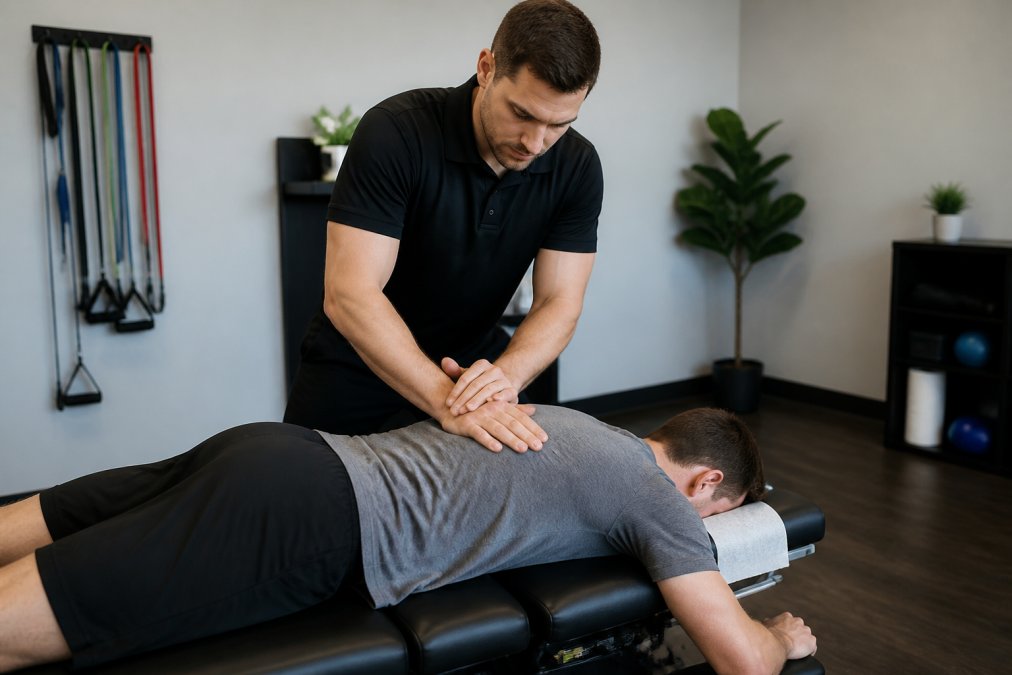
Spinal Adjustment and Mechanical Misalignment
The spinal adjustment is the core tool. Many patients describe it as a quick, targeted pressure rather than the dramatic twist they expected. Afterward, most notice easier movement and less guarding in the surrounding muscles.
A chiropractor may also assess gait, joint mobility, and bio-mechanical function, and may assign functional rehabilitation work to help maintain the correction. Without follow-through, a joint may tend to drift back into its old pattern.
How Acupuncture Works for Sports Pain
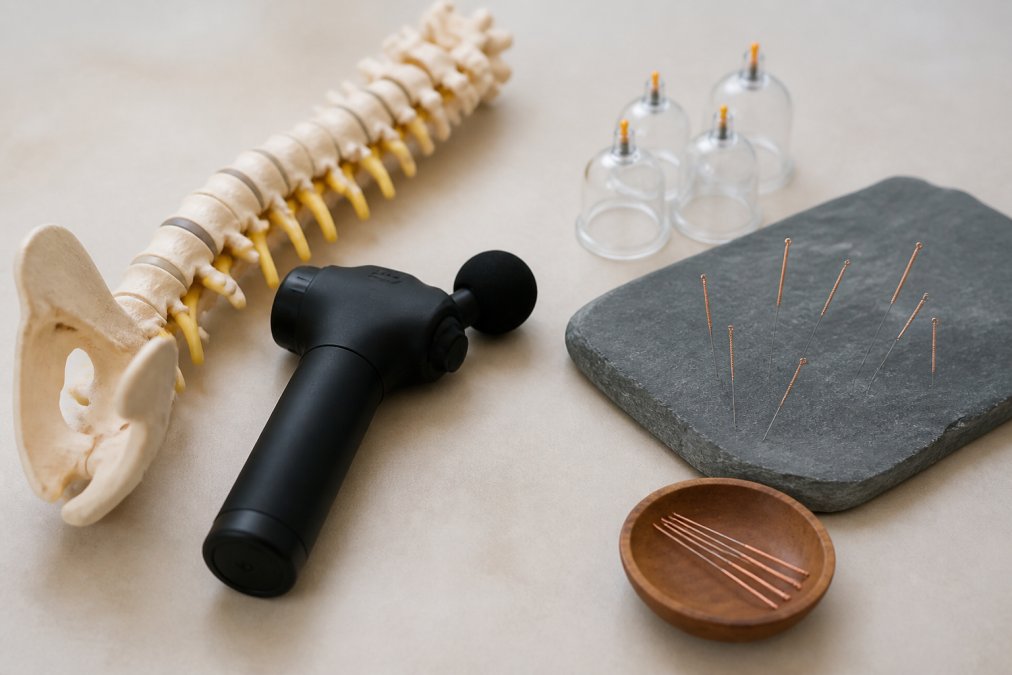
Acupuncture is a traditional Chinese medicine practice in which fine, sterile needles are inserted at specific points on the body. It works through a different route than chiropractic: rather than realigning structure, it aims to influence pain signaling and the body’s own recovery response.
The traditional framework describes meridians, the pathways through which energy harmony is said to flow. A modern clinical explanation focuses on neurological stimulation: needling specific points appears to trigger the release of the body’s natural pain-relieving chemicals and change how pain signals travel to the brain. Either way, the practical target is the same, raising the pain threshold and calming an overactive pain response so tissue healing can proceed.
Acupuncture is often chosen for pain that is widespread, lingering, or tied to inflammation rather than a single stuck joint.
Key Differences Between Chiropractic and Acupuncture
The clearest way to separate them: chiropractic treats mechanical problems with physical force, while acupuncture treats pain signaling with needle-based stimulation. One is structural, one is systemic. But that one-line summary is where most articles stop, and it is not enough to make a real decision. Here is the deeper breakdown.
Training, Licensure, and Scope
A Doctor of Chiropractic (DC) completes a four-year doctoral program after undergraduate study, passes national board exams, and is licensed by a state board, in Texas, that is the Texas Board of Chiropractic Examiners (acatoday.org). Scope includes spinal adjustment, manual therapy, and in many states (including Texas) ordering imaging and providing rehabilitative exercise instruction.
A licensed acupuncturist (L.Ac.) typically completes a master’s-level program of roughly three to four years, hundreds of supervised clinical hours, national board exams through NCCAOM, and state licensure (nccaom.org). In Texas, acupuncture is regulated by the Texas Department of Licensing and Regulation. Scope centers on needle insertion, adjunct modalities like cupping or electroacupuncture, and, in some states, herbal recommendations.
Neither license authorizes the other’s core technique. That is why the two are genuinely complementary rather than interchangeable.
Comparison Table: Chiropractic vs Acupuncture
| Factor | Chiropractic | Acupuncture |
|---|---|---|
| Primary target | Mechanical misalignment, joint mobility | Pain signaling, inflammation reduction |
| Method | Spinal adjustment, manual therapy, rehab exercise | Fine needle insertion at set points; sometimes electroacupuncture |
| Typical provider | Doctor of Chiropractic (DC) | Licensed Acupuncturist (L.Ac.) |
| Texas regulator | Texas Board of Chiropractic Examiners | Texas Department of Licensing and Regulation |
| Best for | Acute sports injury, restricted range of motion, joint restriction | Chronic pain management, widespread pain, pain-dominant patterns |
| Typical session | 20-45 minutes | 30-60 minutes |
| Typical course | 4-12 visits for many musculoskeletal complaints | Often 6-12 sessions for chronic pain |
| Sensation | Targeted pressure, possible cracking sound | Light prick, then dull ache or warmth |
| Insurance | Commonly covered when medically necessary | Coverage varies widely by plan |
| Evidence base | Strong for low back pain and some musculoskeletal conditions | Moderate for chronic low back, neck, and knee osteoarthritis pain |
Injury-Specific Decision Matrix
This is the part most comparisons skip. The right first call depends on what is actually hurt.
| Injury / Pattern | Often Starts With | Why |
|---|---|---|
| Runner’s knee (patellofemoral pain) | Chiropractic + rehab | Hip and knee mechanics and quad/glute strength drive symptoms |
| Golfer’s elbow (medial epicondylitis) | Chiropractic + soft tissue work | Grip and forearm overload tied to shoulder and thoracic mobility |
| Acute low back strain from lifting | Chiropractic | Mechanical restriction responds to adjustment plus movement |
| Chronic, widespread back pain | Acupuncture first, or combined | Pain-signaling modulation often outperforms mechanical-only care here |
| Post-marathon Achilles or plantar pain | Combined | Load management plus pain modulation plus soft tissue work |
| Tension-type headaches after contact sport | Either, based on exam | Cervicogenic headaches often respond to chiropractic; stress-driven patterns to acupuncture |
If your pain is sharp, localized, and clearly tied to one movement, start with a mechanical assessment. If it is dull, diffuse, and worse with stress or poor sleep, acupuncture is often the smarter first stop.
Evidence-Based Research on Pain Relief
Both fields have real research behind them, and both have limits. Chiropractic spinal manipulation has the strongest evidence for acute and chronic low back pain, with guidelines from organizations such as the American College of Physicians listing it among nonpharmacologic options for low back pain (acpjournals.org). Evidence for neck pain is also reasonably strong. Evidence for extremity conditions is more mixed.
Acupuncture has moderate-quality evidence for chronic low back pain, neck pain, and knee osteoarthritis pain, with several systematic reviews finding effects that are modest but real and generally comparable to other non-drug options. For acute sports injuries specifically, the evidence is thinner for both approaches, which is why combining them with load management and rehab is the practical answer.
A common pattern in the research: neither therapy is a standalone cure. Both work best as part of a plan that includes exercise, load management, and sleep.
Benefits of Chiropractic for Athletes
For athletes, the benefits of chiropractic for athletes center on restoring bio-mechanical function so the body can perform and recover the way it is supposed to. When a joint moves freely, the muscles around it stop compensating, and that alone can ease a surprising amount of pain.
Athletes commonly seek chiropractic care for:
- Acute sports injury, such as a tweaked back or locked-up shoulder
- Restricted range of motion that is limiting a lift, swing, or stride
- Recurring soft tissue tension that keeps returning to the same spot
- Preventative care to keep small restrictions from becoming injuries
Ask your chiropractor to explain what they found and why, in plain language, before any adjustment. A practitioner who can map your pain to a specific mechanical restriction is usually the one who will get you back to your sport faster.
Recovery Time for Sports Injuries: What to Expect
Recovery time for sports injuries depends far more on the injury itself than on which therapy you choose. A mild strain may settle in days, while a significant sprain or a chronic overuse problem can take weeks to months. No practitioner can honestly promise a fixed timeline before assessing you.
What matters is matching the therapy to the stage of healing. In the early, inflamed phase, gentle care and pain control come first. As tissue heals, the focus shifts to restoring range of motion and rebuilding strength. This is where a personalized plan beats a one-size-fits-all package.
Pushing through sharp pain to “test” whether a treatment worked is one of the most common mistakes we see. It can re-irritate healing tissue and set recovery back by weeks.
Integrative Pain Management for Athletes
Integrative pain management for athletes means combining approaches rather than choosing one and abandoning the other. Chiropractic can address the structural restriction while acupuncture helps calm the pain response, and the two often work well together for stubborn or complex injuries.
The order and mix depend on your situation. An athlete with a fresh, mechanical injury may start with chiropractic care and add acupuncture if pain lingers. Someone dealing with long-standing chronic pain may benefit from the reverse. This is complementary medicine at its most practical: each therapy doing what it does best.
A San Antonio Sports Context
San Antonio athletes are not a generic population. Between the Rock ‘n’ Roll Running Series, the San Antonio Sports Fit Family Challenge, high school football across the Northside and North East ISDs, and year-round trail and road running on the Salado Creek and Leon Creek greenways, the local injury mix skews toward running overuse, football contact injuries, and heat-related training stress. That matters because the therapy that fits a runner’s knee is not the same as the one that fits a golfer’s elbow or a football player’s stinger.
If you train outdoors here, plan around the summer: May through September, morning sessions before 9 a.m. and hydration matter more than any single treatment choice. A chiropractor or acupuncturist who understands the local training calendar will build a plan around your race or season, not around a fixed package of visits.
Cost Comparison and Insurance Coverage in Texas
Cost is where most comparisons get vague, so here is the honest version, with the caveat that actual numbers depend on your plan and the clinic.
Chiropractic. Most major health insurance plans in Texas, including BCBS of Texas, UnitedHealthcare, Aetna, and Cigna, cover chiropractic care when it is medically necessary for a covered condition such as low back pain. Typical in-network copays for chiropractic care can be similar to a specialist visit, often with a limited number of visits per year. Out-of-network or cash-pay visits in San Antonio may vary, with initial exams often being higher.
Acupuncture. Coverage is far less consistent. Some Texas plans cover acupuncture for specific diagnoses such as chronic low back pain or nausea, often with a visit cap and a higher copay. Many plans exclude it entirely. Cash-pay acupuncture in San Antonio may vary, with community-style or sliding-scale clinics sometimes offering lower rates.
Medicare and Medicaid. Medicare Part B does not routinely cover acupuncture except for a narrow chronic low back pain benefit, and chiropractic coverage is limited to manual manipulation of the spine. Texas Medicaid coverage varies by program and is generally narrow for both.
HSA/FSA. Both chiropractic and acupuncture are commonly eligible for reimbursement from a Health Savings Account or Flexible Spending Account with a Letter of Medical Necessity, even when insurance does not cover them. That can effectively reduce the after-tax cost.
A few questions worth asking any clinic:
- Is my specific plan accepted, and what is my copay or coinsurance?
- How many visits are typically needed for my type of injury?
- Will I get a written treatment plan with clear goals?
- Do you offer cash-pay rates, and are they HSA/FSA eligible?
- [ ]
The cheapest visit is not the best value if it does not address the cause. Ask for a clear plan with defined goals, then judge cost against results, and check your HSA/FSA options before assuming you are paying full price.
What to Expect During Your First Visit
A first chiropractic visit usually includes a health history, a physical and biomechanical exam, and often imaging if red flags are present. Treatment may or may not happen the same day, depending on findings. A first acupuncture visit typically includes a longer intake, sometimes 60-90 minutes, covering pain patterns, sleep, stress, and digestion, followed by a first needling session.
Bring the same things to both: a list of medications, any recent imaging, a description of when the pain started and what makes it worse, and your training schedule. The more specific you are about your sport and your goals, the more specific the plan will be.
Frequently Asked Questions
Is acupuncture or chiropractic care better for a pinched nerve?
It depends on the cause of the pinched nerve. Chiropractic care addresses mechanical misalignment that may be compressing a nerve, using spinal adjustment to restore joint mobility and reduce nerve conduction interference. Acupuncture targets pain signaling and inflammation through neurological stimulation. A qualified provider can assess whether your pinched nerve stems from a structural issue or an inflammatory one, which determines which approach, or combination, makes sense for your recovery.
Can I combine chiropractic care and acupuncture for faster sports injury healing?
Yes, many athletes use both as part of an integrative pain management plan. Chiropractic care restores spinal alignment and joint mobility, while acupuncture addresses soft tissue tension and pain signaling. Combining them may support tissue healing and reduce recovery time for sports injuries, though the right sequence and frequency depend on your specific injury. A provider experienced in both modalities can build a coordinated plan rather than treating them as separate tracks.
Do professional athletes use chiropractors and acupuncture?
Many professional athletes in the U.S. use chiropractic care for musculoskeletal health, joint mobility, and preventative care between competitions. Acupuncture is also common among athletes for pain management and inflammation reduction. Neither is a replacement for medical diagnosis, but both are used as complementary medicine alongside standard sports medicine. The choice often comes down to whether the athlete’s primary issue is structural or systemic.
What are the primary differences between chiropractic adjustments and acupuncture needles?
Chiropractic adjustments are manual or instrument-assisted movements that correct mechanical misalignment and restore range of motion in the spine and joints. Acupuncture uses thin needles placed at specific points to stimulate neurological pathways and support the body’s own pain modulation. Chiropractic focuses on bio-mechanical function; acupuncture focuses on pain threshold and tissue healing. Both are evidence-based practices when delivered by a licensed provider.
How much does chiropractic care cost compared to acupuncture?
Pricing depends on your location, provider, and treatment plan. Chiropractic care is more commonly covered by health insurance in the U.S., which can lower out-of-pocket costs for eligible patients. Acupuncture coverage varies by plan and often requires more out-of-pocket spending. Contact Moore Chiropractic for a complimentary evaluation and consultation and current pricing information specific to your situation.