Radiating Leg Pain
Pain may travel from the lower back or buttock into the thigh, calf, or foot.

Sciatica Treatment in San Antonio
Pain that travels from your lower back or buttock into your leg can interfere with walking, sitting, working, exercising, and sleeping. Moore Chiropractic provides personalized evaluation and conservative chiropractic care for San Antonio patients experiencing sciatica and other musculoskeletal causes of radiating leg pain.
Understanding Sciatic Nerve Pain
Sciatica describes pain and other symptoms that follow the path of the sciatic nerve, usually from the lower back or buttock into one leg. It commonly occurs when a nerve root in the lower spine becomes irritated or compressed.
The sciatic nerve is formed by nerve roots from the lower spine and travels through the buttock and down the leg. Sciatica is a symptom pattern rather than one single disease, and symptoms can vary depending on which nerve structures are affected.
Not everyone with sciatica has significant lower-back pain, and not every type of leg pain is sciatica.

Common Symptoms
Sciatica can feel different from person to person. The location and type of symptoms provide clues, but symptoms alone cannot determine the exact cause.
Pain may travel from the lower back or buttock into the thigh, calf, or foot.
Some patients describe the sensation as burning, shooting, electric, or sharp.
Pins-and-needles sensations may occur along part of the leg or foot.
Areas of reduced sensation can occur when nerve function is affected.
Some nerve problems can affect muscle strength in the leg or foot.
Symptoms may worsen with prolonged sitting or certain positions in some patients.
Possible Sources
Sciatica can occur when nerve roots that contribute to the sciatic nerve become irritated or compressed. Several spinal and musculoskeletal conditions can produce this symptom pattern.
Disc material can sometimes irritate or compress a nearby spinal nerve root.
Learn about herniated discs →Narrowing around spinal nerve structures can contribute to radiating leg symptoms in some patients.
Age-related changes in discs and joints may reduce available space around nerve structures in some cases.
Movement or displacement of one vertebra relative to another can sometimes contribute to nerve irritation.
The sciatic nerve can sometimes become irritated near the piriformis muscle in the buttock.
Injuries or inflammation affecting tissues around the lower spine or pelvis can sometimes contribute to nerve-related symptoms.
Know the Difference
A patient can have lower-back pain, sciatica, or both at the same time.
Often remains primarily around the lumbar region and may involve:
Typically involves neurological symptoms traveling from the lower back or buttock into the leg, such as:
Conservative Care
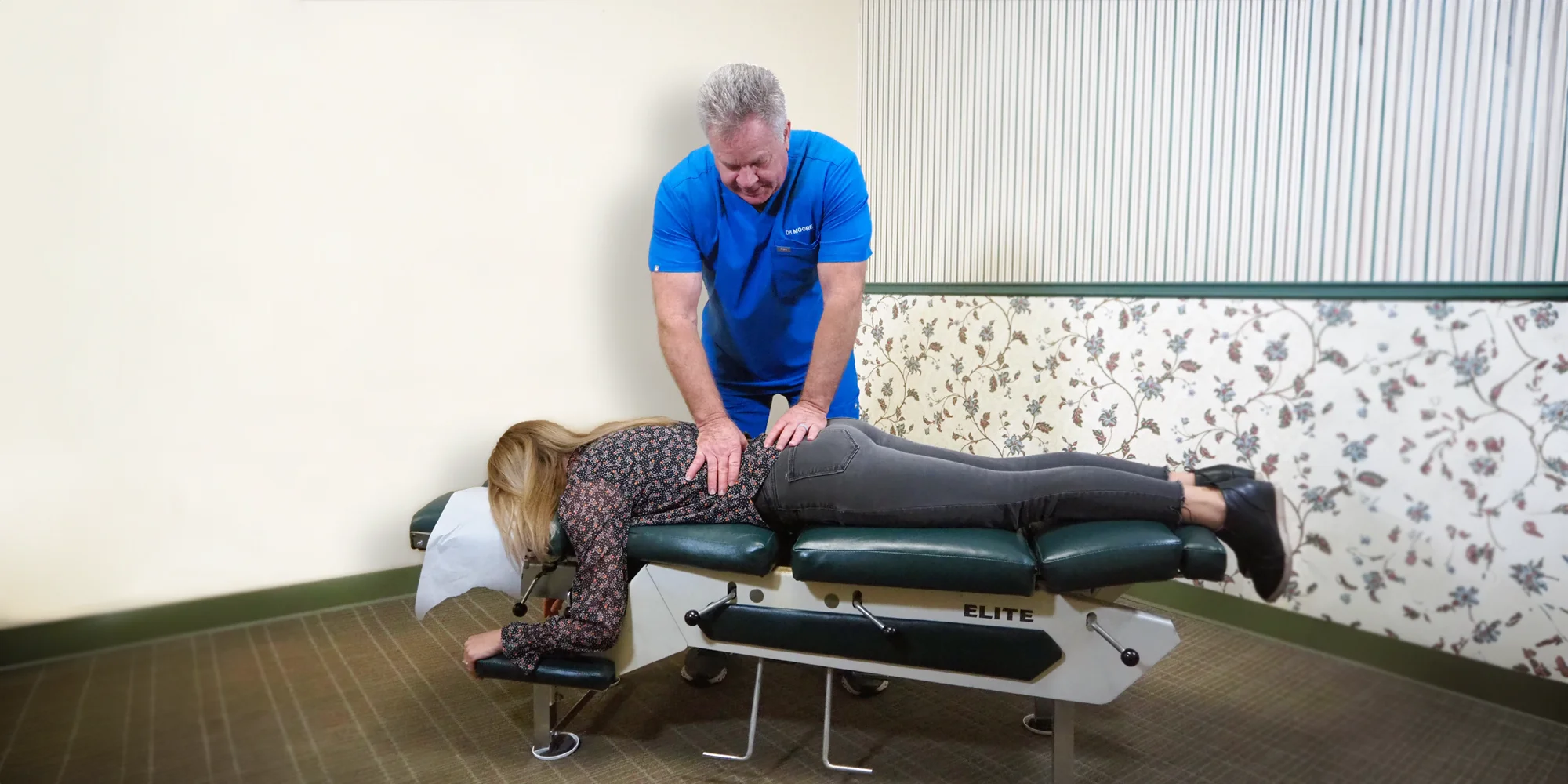
Chiropractic care may be appropriate for some patients with sciatica when symptoms are related to musculoskeletal or mechanical factors that can be managed conservatively. The appropriate treatment depends on what is contributing to the nerve irritation and the patient's individual examination.
Care may include, when appropriate, chiropractic adjustments, joint mobilization, movement recommendations, activity modification, posture or ergonomic guidance, appropriate exercises, and other conservative approaches used by the practice.
The goal is not simply to “realign the spine.” It is to evaluate relevant musculoskeletal factors, improve movement when appropriate, and develop care based on the individual patient's presentation.
Disc-Related Symptoms
Yes. A herniated or bulging lumbar disc can sometimes irritate or compress a spinal nerve root and produce pain, numbness, tingling, or weakness that travels into the leg.
A disc finding on imaging does not automatically mean it is responsible for a patient's symptoms. Clinical findings and symptoms need to be considered together.
Chiropractic care does not “put a disc back in place.” Whether conservative care is appropriate depends on the individual presentation.
Learn More About Herniated Discs
Finding the Likely Source
The goal is to understand your symptoms, evaluate relevant musculoskeletal findings, and determine whether conservative chiropractic care may be appropriate.
Review where symptoms begin and travel, when they started, aggravating factors, previous injuries, activity, and relevant medical history.
Assess relevant movement and musculoskeletal findings and consider symptoms such as numbness, tingling, or weakness.
Consider whether conservative chiropractic care may be appropriate or whether further medical evaluation or referral is needed.
When chiropractic care is appropriate, recommendations reflect your findings, symptoms, goals, and response.
Patient Experiences
Read current patient feedback about Moore Chiropractic.
Similar Symptoms, Different Sources
No. Classic sciatica generally involves irritation of nerve roots in the lower spine, while piriformis-related sciatic nerve irritation occurs farther along the nerve near the buttock.
Symptoms are generally associated with irritation or compression of nerve roots in the lower spine and can travel into the leg.
Irritation occurs closer to the buttock. It may produce buttock pain, leg pain, tingling, or discomfort with certain movements or positions.
Because these symptom patterns can overlap, evaluation is important when distinguishing among possible sources.
Recovery Varies
There is no single recovery timeline for sciatica. Duration depends on the underlying cause, severity of nerve irritation, how long symptoms have been present, activity demands, health factors, and response to treatment.
Some episodes improve relatively quickly while others persist or recur and may require additional evaluation. A predetermined number of visits or guaranteed recovery timeline is not appropriate for every patient.
Know the Warning Signs
Most sciatica is not a medical emergency, but certain neurological symptoms require immediate evaluation.
These symptoms can indicate serious nerve compression and require urgent or emergency medical evaluation rather than routine chiropractic care.
Personalized Sciatica Care
Moore Chiropractic provides individualized conservative care from a convenient McCullough Ave location in San Antonio.
Dr. Moore has more than three decades of chiropractic experience.
Recommendations are based on symptoms, findings, goals, and individual needs.
Chiropractic care may provide a non-surgical conservative option for appropriate musculoskeletal cases.
Care focuses on mobility and physical function when clinically appropriate.

Your San Antonio Chiropractor
Dr. Andrew “Andy” Moore is the founder and primary chiropractor at Moore Chiropractic in San Antonio. A 1988 graduate of Parker Chiropractic, he brings more than three decades of chiropractic experience to evaluating and caring for musculoskeletal complaints.
His background as an exercise physiologist and his experience in running, swimming, and triathlons contribute to his practical understanding of movement, activity, and individualized patient goals.
Meet Dr. MooreCommon Questions
Convenient San Antonio Location
Moore Chiropractic
8507 McCullough Ave Suite A-1
San Antonio, TX 78216
Phone: (210) 525-9063
Hours:
Monday–Thursday: 7:00 AM–6:00 PM
Friday: 7:00 AM–12:00 PM
Saturday & Sunday: Closed
Moore Chiropractic • San Antonio, TX
If pain, tingling, numbness, or other symptoms are traveling from your lower back or buttock into your leg, schedule an appointment with Moore Chiropractic to have your symptoms evaluated and determine whether conservative chiropractic care may be appropriate for you.