

Table of Contents
- Factors That Determine How Many Chiropractic Visits You’ll Need
- Acute Pain vs. Chronic Pain: Different Treatment Paths
- Understanding Your Chiropractic Treatment Plan Duration
- What to Expect During Your First Visit and Initial Phase
- Signs Chiropractic Adjustment Is Working
- Chiropractic Maintenance Care vs. Acute Care: When to Stop and When to Continue
- Red Flags for Over-Treatment and Home-Based Exercises to Support Your Recovery
- Conclusion
Last Updated: August 7, 2026
Factors That Determine How Many Chiropractic Visits You’ll Need
The number of chiropractic visits required depends on several interconnected factors specific to your condition, body, and recovery goals. Understanding these variables helps you set realistic expectations and avoid both under-treatment and unnecessary prolonged care.
Severity of your condition is the primary driver. Acute injuries like muscle strain or whiplash typically require fewer visits than chronic conditions developed over months or years. A minor subluxation causing localized neck pain may resolve in 3-6 visits, while a long-standing degenerative disc condition might require 12-20 visits initially.
Your age and overall health influence recovery speed significantly. Younger patients with good overall health tend to respond faster to treatment. Patients with multiple comorbidities, poor posture habits, or sedentary lifestyles often need extended care because their bodies have more ground to recover.
The specific anatomical area matters. Neck and lower back pain respond differently. Cervical spine issues sometimes require more frequent visits early on due to the region’s complexity, while lumbar pain often stabilizes more quickly with proper biomechanical correction.
Patient compliance between visits is crucial. People who follow home exercise recommendations, maintain good posture, and avoid aggravating activities progress faster. Those who continue the same habits that caused the injury often plateau or regress, requiring additional visits.
Your treatment goals also shape visit frequency. If you’re seeking pain relief only, you might achieve that in fewer visits. If your goal is complete functional restoration and returning to sports or demanding work, expect a longer treatment timeline.
The first consultation should include a thorough assessment and a realistic estimate of how many visits your specific condition typically requires. Red flags that suggest over-treatment: being told you need unlimited visits without a clear endpoint, or being pressured into long-term packages before your condition has been properly evaluated.
Acute Pain vs. Chronic Pain: Different Treatment Paths
Acute pain and chronic pain require fundamentally different treatment approaches, and the distinction directly affects how many chiropractic visits you’ll need.
Acute pain develops suddenly from a specific incident like a sports injury, motor vehicle accident, or awkward lifting. This pain typically lasts days to weeks. The underlying tissue damage is recent, inflammation is active, and your body’s healing response is in full gear. Acute pain conditions respond well to chiropractic care because injured tissues are in an acute inflammatory phase where manipulation, soft tissue therapy, and mobility work facilitate recovery.
For acute pain, most patients see improvement within 2-4 weeks with 2-3 visits per week initially. Once pain decreases significantly, visits taper to once weekly, then once every two weeks. Total visit count often ranges from 6-12 sessions for straightforward acute injuries.
Chronic pain persists for more than 12 weeks and usually develops gradually from repetitive strain, poor posture, or underlying degenerative conditions. Chronic pain is more complex because the nervous system becomes sensitized, pain signals persist even after initial tissue healing, scar tissue may have formed, and patients often have secondary muscle tension from guarding and compensation.
Chronic pain requires a longer treatment arc. The initial phase focuses on reducing pain and improving mobility, typically requiring 2-3 visits weekly for 4-6 weeks. Once pain is controlled, the middle phase shifts to corrective care and functional restoration, usually 1-2 visits weekly for another 4-8 weeks. Finally, maintenance care prevents relapse. Total initial treatment for chronic conditions often ranges from 16-24 visits over 8-12 weeks, followed by ongoing maintenance.
The key difference: acute pain is about facilitating healing of fresh injury, while chronic pain is about retraining the nervous system, rebuilding movement patterns, and preventing relapse.
Acute injuries typically resolve in 6-12 visits over 3-4 weeks. Chronic conditions require 16-24+ visits over 8-12 weeks, then ongoing maintenance to prevent recurrence.
Understanding Your Chiropractic Treatment Plan Duration
A structured chiropractic treatment plan divides your care into distinct phases, each with different visit frequency and objectives.
Phase 1: Acute Management (Weeks 1-4)
This phase addresses immediate pain and inflammation with 2-3 visits per week. The chiropractor performs spinal manipulation to restore mobility, reduces inflammation through soft tissue techniques, and may use modalities like ice or heat. By the end of this phase, you should notice significant pain reduction, typically 50-70% improvement from baseline.
Phase 2: Corrective Care (Weeks 5-12)
Once acute pain is controlled, the focus shifts to correcting underlying biomechanical issues. Visit frequency drops to 1-2 times weekly. This phase rebuilds strength, restores full range of motion, and retrains movement patterns. Home exercises become increasingly important as you learn how to move without pain and prevent recurrence.
Phase 3: Maintenance and Prevention (Week 12 onward)
After your condition has stabilized, maintenance visits help prevent relapse. Frequency drops to once monthly or less, depending on your activities and risk factors. Many patients in San Antonio who work desk jobs benefit from monthly adjustments to counteract postural stress.
The total duration depends on your starting point. A straightforward acute neck strain might complete all three phases in 6-8 weeks. A complex chronic lower back condition might take 12-16 weeks to stabilize, then require ongoing maintenance.
What to Expect During Your First Visit and Initial Phase
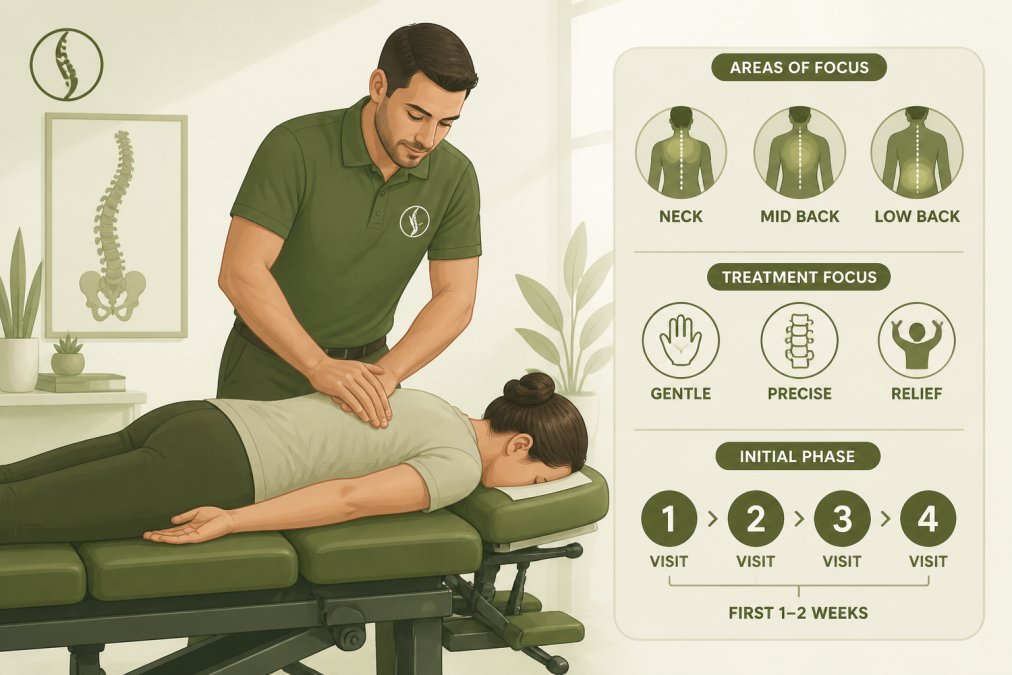
Your first chiropractic visit is a comprehensive assessment. Plan for 45-60 minutes. The chiropractor will take a detailed history: when your pain started, what makes it better or worse, your work environment, previous injuries, and your health goals. Next comes a physical examination assessing your posture, range of motion, spinal alignment, and muscle strength. They’ll perform orthopedic and neurological tests specific to your complaint. If needed, they might order X-rays or refer you for imaging to rule out serious underlying conditions.
During the first visit, many chiropractors perform an initial adjustment or soft tissue work, but the primary goal is assessment and education. You should leave understanding what’s wrong, why it happened, and what the treatment plan looks like, including realistic expectations for visit frequency and recovery timeline.
The initial phase following your first visit usually involves frequent visits, often 2-3 times per week for the first 2-4 weeks. These frequent visits allow the chiropractor to monitor your response, adjust techniques as needed, and reinforce movement patterns through repeated correction. Pain typically drops fastest during this phase.
You’ll also receive home care instructions: specific exercises, postural corrections, ergonomic adjustments, or activity modifications. Compliance here directly impacts your outcome. Patients who follow these recommendations consistently progress faster and often need fewer total visits.
If your pain hasn’t improved at all after 4-6 visits, or if it worsens, that’s a red flag. It may indicate your condition requires a different approach, imaging to rule out serious pathology, or referral to another specialist. A good chiropractor will recognize when chiropractic isn’t the right fit and refer you accordingly.
Signs Chiropractic Adjustment Is Working
Knowing what improvement looks like helps you distinguish between normal progress and stalled recovery.
Pain reduction is the most obvious sign. You should notice decreasing pain intensity, reduced frequency of pain episodes, or pain that resolves more quickly after activity. This typically begins within 2-3 visits for acute conditions. For chronic pain, improvement may be more gradual, perhaps a 10-15% reduction every 1-2 weeks.
Improved range of motion often appears before pain fully resolves. You might notice you can turn your head further without discomfort, bend forward with less restriction, or rotate your spine more freely. This functional improvement indicates the underlying mobility restriction is improving.
Reduced muscle tension is another positive sign. Muscles that were constantly tight and guarded begin to relax. You might notice your shoulders sit lower, your neck feels less stiff in the morning, or tension headaches decrease.
Better sleep quality often improves as pain decreases. Many patients report falling asleep easier, sleeping through the night, or waking with less morning stiffness.
Improved tolerance for activities is a functional marker. You can sit at your desk longer without pain escalating, exercise with less discomfort, or perform activities that previously triggered flare-ups.
Longer intervals between pain episodes shows that your condition is stabilizing. If you initially had daily pain, then pain 4 days per week, then 2 days per week, that’s clear evidence of improvement.
Signs that something isn’t working: no change after 6-8 visits, pain that worsens with each adjustment, or improvement that completely plateaus for 2+ weeks despite consistent treatment. These warrant a conversation with your chiropractor about adjusting your approach or seeking a second opinion.
Chiropractic Maintenance Care vs. Acute Care: When to Stop and When to Continue
Understanding the difference between corrective care and maintenance care prevents both under-treatment and unnecessary prolonged visits.
Corrective care is active treatment for an existing problem. You have pain, dysfunction, or a diagnosed condition, and visits are specifically designed to resolve it. Frequency is higher (1-3 times weekly), and the goal is clear: eliminate pain and restore function. This phase has a defined endpoint.
Maintenance care is preventive. You’re no longer in active pain or dysfunction. Instead, you’re visiting periodically to prevent problems from recurring. Frequency is much lower, typically once monthly or every 4-6 weeks. Maintenance care is optional; it’s a choice to invest in prevention rather than waiting for pain to return.
The transition happens when you’ve achieved your treatment goals. Your chiropractor should tell you explicitly: "Your acute condition has resolved. We can now move to maintenance care if you’d like, or you can stop treatment and return if problems develop."
When to continue beyond corrective care:
- You have a job or hobby that stresses your spine repeatedly (desk work, heavy lifting, competitive sports)
- You have a history of recurring problems in the same area
- You’re experiencing early warning signs of relapse
- Your chiropractor identifies biomechanical issues that will likely cause problems again without maintenance
When to stop:
- You’ve achieved your treatment goals and your condition is stable
- You’re not having recurrent problems
- You’re willing to accept the risk that pain might return without preventive care
Many patients in San Antonio benefit from monthly maintenance visits because desk-heavy work creates ongoing postural stress. But this should be your choice, not a requirement imposed by your chiropractor.
Maintenance care works best for people with recurring issues, high-stress occupations, or active lifestyles. If you had one acute injury and recovered fully with no history of similar problems, you may not need ongoing visits.
Red Flags for Over-Treatment and Home-Based Exercises to Support Your Recovery
Over-treatment is a real concern in chiropractic care. Some practitioners recommend excessive visits or indefinite care when evidence doesn’t support it.
Red flag: Recommending long-term care packages before proper evaluation. A legitimate treatment plan emerges from assessment, not from a pre-set package. A proper plan says, "We’ll treat for 4-6 weeks, then reassess and adjust based on your progress."
Red flag: Claiming chiropractic is the only solution and discouraging other providers. A responsible chiropractor refers patients to medical doctors, physical therapists, or specialists when appropriate.
Red flag: Pushing unlimited maintenance visits. While maintenance care has value, it should be your choice based on your needs. Once monthly is reasonable for maintenance; once weekly indefinitely is excessive for someone not in active pain.
Red flag: No clear improvement after 6-8 visits. If your condition hasn’t improved meaningfully after 6-8 sessions, reassess whether chiropractic is the right treatment for your specific problem.
Home-based exercises are your most powerful tool for supporting recovery and preventing relapse. These aren’t optional, they’re essential. Exercises address the underlying biomechanical problems that led to your pain.
Common home exercises include:
- Neck stabilization exercises for cervical pain: gentle isometric holds, chin tucks, and scapular retractions
- Core strengthening for lower back pain: planks, bird dogs, and dead bugs
- Stretching routines targeting tight muscles: hamstring stretches, hip flexor stretches, and thoracic rotations
- Postural correction drills performed throughout the day: shoulder rolls, spinal extensions, and posture resets at your desk
Consistency matters more than intensity. Performing exercises 5-6 days per week for 10-15 minutes beats sporadic longer sessions. Most patients who do their home exercises progress faster and need fewer total visits.

Your chiropractor should teach you proper form and progression. As your condition improves, exercises evolve from basic mobility work to strengthening and functional training.
Determining the right number of chiropractic visits for pain requires honest assessment of your condition, clear communication with your provider, and realistic expectations about recovery timelines. Acute pain typically resolves in 6-12 visits over 3-4 weeks. Chronic conditions usually require 16-24 visits over 8-12 weeks, followed by optional maintenance care. The key is distinguishing between necessary corrective care and excessive treatment, maintaining compliance with home exercises, and recognizing when your condition has stabilized. At Moore Chiropractic in San Antonio, we provide personalized treatment plans tailored to your specific condition, not predetermined packages. Our approach includes a thorough initial evaluation, clear communication about expected visit frequency and duration, and a transition to maintenance care only when appropriate. If you’re dealing with back pain, neck pain, or sports injuries, contact Moore Chiropractic for a complimentary evaluation to understand exactly how many visits your condition requires and how we can support your recovery with gentle, evidence-based care.
Frequently Asked Questions
How do I know if chiropractic is actually working for my pain?
Signs of progress include reduced pain intensity, improved range of motion, better sleep quality, and increased ability to perform daily activities. Many patients notice gradual improvements over 2-4 weeks of consistent treatment. Keep track of your pain levels and functional improvements between visits. If you're not seeing measurable progress after your initial treatment plan phase, discuss this with your chiropractor during your re-evaluation to adjust your approach.
What's the typical cost commitment for chiropractic treatment?
The total cost depends on your specific condition, treatment plan duration, and whether insurance covers your visits. Pricing varies based on the complexity of your case and frequency of adjustments needed. Contact Moore Chiropractic for a personalized quote after your complimentary evaluation. Many insurance plans cover chiropractic care, so verify your coverage before starting treatment to understand your out-of-pocket costs.
Can chiropractic care really help chronic pain that hasn't responded to other treatments?
Chiropractic care addresses musculoskeletal causes of chronic pain through spinal manipulation and soft tissue therapy. Many patients with long-standing pain find relief when the underlying biomechanical issues are corrected. However, results vary based on your specific condition, how long you've had pain, and your commitment to the treatment plan and home exercises. A complimentary consultation with Moore Chiropractic can help determine if your pain is likely to respond to chiropractic treatment.
How many visits do most people need before they feel better?
Acute injuries often improve within 4-8 visits over 2-3 weeks, while chronic conditions typically require 8-12 weeks of consistent care with 2-3 visits per week initially. Your chiropractor will create a personalized timeline based on your condition severity, age, and overall health. Many patients report noticeable improvement within the first 2-3 weeks, though significant functional restoration may take longer. Your treatment plan will be adjusted based on your progress and re-evaluation findings.
This article was written using GrandRanker