Last Updated: November 5, 2026
Quick Summary
Pediatric chiropractic for sports injuries in active children uses gentle, hands-on care to check how a child’s joints and muscles move and to support the body’s own healing, without forceful adjustments to a growing spine. It works best as one supportive piece of a broader plan, since evidence that it prevents injuries or shortens recovery is limited.
- Growth plates are weaker than surrounding ligaments, so a twist can fracture a child’s bone.
- Common injuries include ankle sprains, knee pain, Little League shoulder and elbow, and shin splints.
- Skip chiropractic and seek medical evaluation for suspected fractures, deformity, or inability to bear weight.
- Return to sports follows six steps, from protecting the area to a gradual return with a re-check.
- A child is ready to progress when strength and balance are roughly equal on both sides.
Table of Contents
- Why Active Children Face Unique Musculoskeletal Stress
- Common Sports Injuries in Children and Young Athletes
- How Pediatric Chiropractic Supports Recovery and Movement
- Chiropractic Care Safety for Children: What Parents Should Know
- When to See a Doctor for a Child Sports Injury
- Return to Sports After Injury for Kids: A Step-by-Step Pathway
- What to Expect at a San Antonio Pediatric Chiropractic Visit
- Book Your Child’s Complimentary Evaluation
- Frequently Asked Questions
Why Active Children Face Unique Musculoskeletal Stress
Pediatric chiropractic for sports injuries in active children starts with one fact: kids are not small adults. Their bones are still growing, their joints are looser, and their growth plates are soft spots that injuries love. Young athletes’ bodies take a very different kind of pounding than an adult’s does.
Growth plates are the open ends of growing bones. They are weaker than the surrounding ligaments. That is why a twist that sprains an adult’s ankle can fracture a child’s.
Add the load. Young athletes often play one sport all year. They carry heavy backpacks. They grow fast, and coordination lags behind. The result is physical stress that builds quietly.
Watch out: pain that lasts more than a few days is not “just growing pains.” Growing pains usually hit both legs in the evening and ease by morning. Pain in one joint, or pain that limps, needs a closer look.
Common Sports Injuries in Children and Young Athletes
The most common sports injuries in children are sprains, strains, and overuse injuries. Sprains stretch or tear ligaments. Strains pull muscles or tendons. Overuse injuries build from repeated motion without enough rest.
Here is what we see most often:
- Ankle sprains from cutting and landing
- Knee pain from jumping and running
- Little League shoulder and elbow from throwing
- Lower back pain from twisting and lifting
- Shin splints from hard surfaces and sudden mileage jumps
- Heel pain during growth spurts
Falls cause many acute injuries. Overuse causes most of the nagging ones. Both deserve attention, because untreated problems in a growing body can change how a child moves for years.
How Pediatric Chiropractic Supports Recovery and Movement
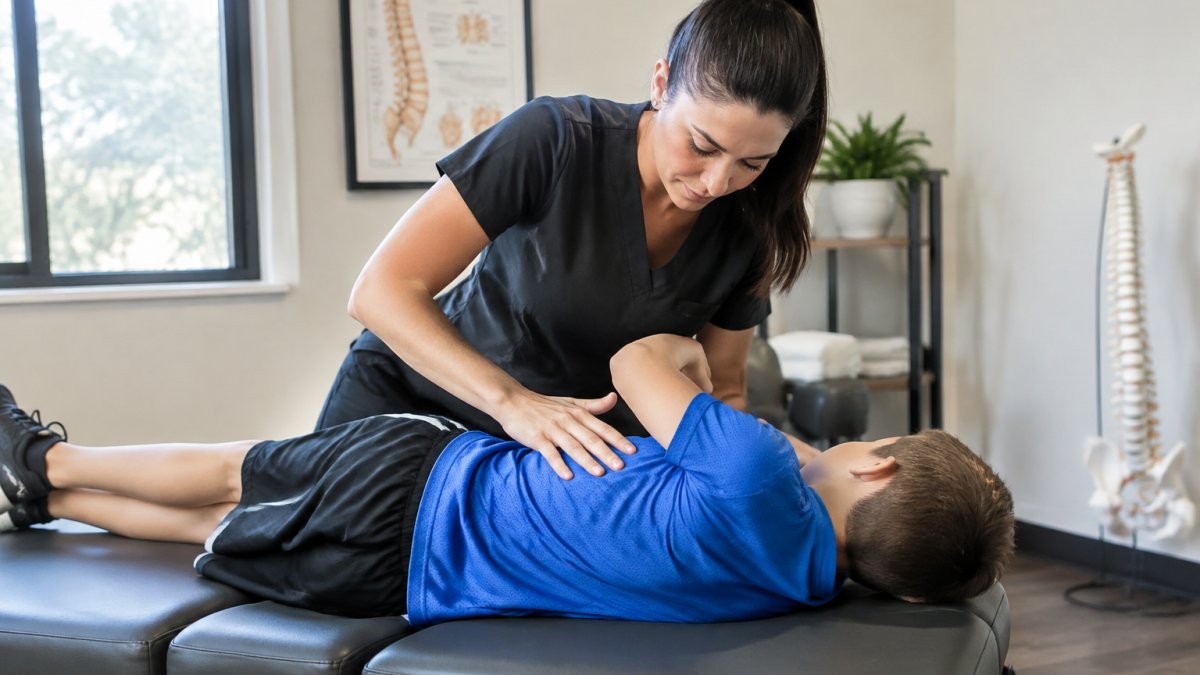
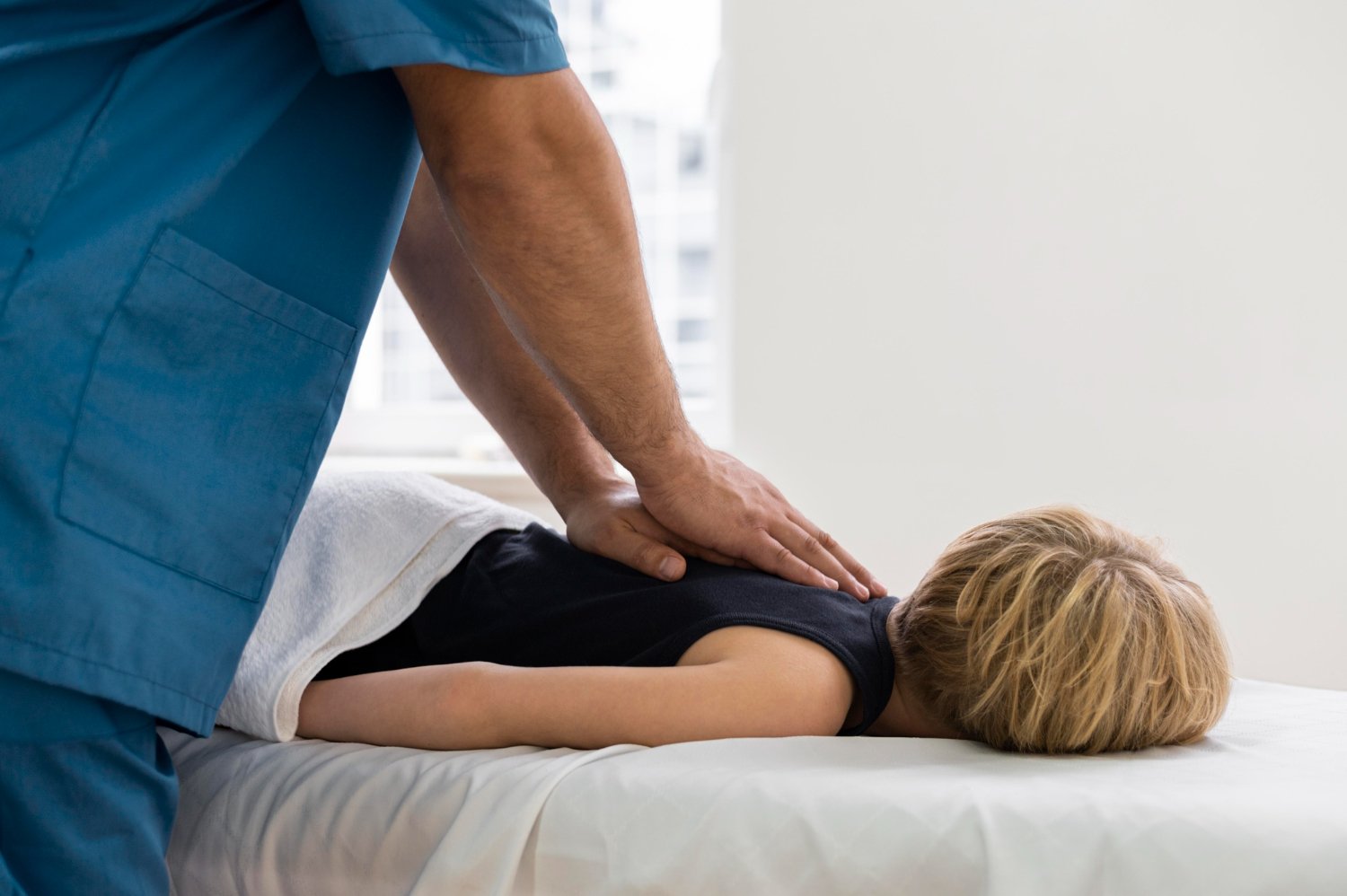
Pediatric chiropractic is a gentle, hands-on approach that checks how a child’s joints and muscles move, then supports the body’s own healing. It does not involve forceful adjustments to a growing spine. Light pressure and motion can help joints move well.
The goal is simple: restore normal movement so the child’s body can heal and perform. For young athletes recovering from sports injuries, chiropractic care for youth sports injury recovery focuses on gentle techniques and a safe return to play.
Joint Mobility and Restoring Proper Movement Patterns
When a joint stiffens after an injury, the body finds a workaround. That workaround is a bad habit. A limping ankle changes the knee. A guarded shoulder changes the throw.
Assessing joint movement first and then using gentle motion to restore it is one approach a provider may take. Retraining the pattern afterward, such as how a child lands, runs, or swings, can help prevent a return to the same problem.
Muscle Imbalances, Stiffness, and Posture
Muscle imbalances are the quiet problem. One side gets strong. The other gets stiff. Posture drifts.
A common mistake is stretching only the tight side. In practice, the weak side needs the work. Light soft-tissue work paired with simple strength and posture exercises is one approach a provider may use.
Chiropractic Care Safety for Children: What Parents Should Know
Chiropractic care safety for children comes down to three things: the provider’s pediatric training, the gentleness of the technique, and an honest assessment of whether chiropractic is the right tool for this injury at all. Gentle, age-appropriate care for kids looks nothing like an adult adjustment. Pressure is light. Positions are comfortable. The child’s size, stage of development, and sport guide every choice.
What the evidence does and does not show
Be skeptical of anyone who promises that chiropractic will prevent injuries or speed healing. The honest position is narrower. Gentle manual therapy may improve comfort and joint motion in some children with mild musculoskeletal complaints, but high-quality pediatric sports research is limited. No credible body of evidence shows that spinal manipulation prevents sports injuries in children or shortens recovery from fractures, growth-plate injuries, or significant ligament tears. That is why a good provider frames chiropractic as one supportive piece of a broader plan, not a cure-all.
When chiropractic is not appropriate
Some situations call for a physician first, not a adjustment table. Skip chiropractic and seek medical evaluation when a child has:
- A suspected fracture, deformity, or a joint that looks out of place
- Inability to bear weight or use the limb normally
- Severe or rapidly worsening pain, or significant swelling
- Numbness, tingling, weakness, or other neurological symptoms
- A head or neck injury, confusion, vomiting, or loss of consciousness
- Fever with joint pain, or unexplained weight loss
- A known bone condition, bleeding disorder, or recent surgery in the area
These are not gray areas. They are reasons to route the child to urgent care, the pediatrician, or sports medicine before any hands-on treatment.
Questions to ask before care starts
Ask any provider:
- What training and experience do you have treating children and adolescents?
- What will the first visit involve, and will you adjust the spine?
- What are the risks, and what would make you stop care?
- When would you refer us to a pediatrician, sports medicine physician, or physical therapist?
A good provider answers all four plainly and says “no” when care isn’t right. Watch out: be wary of any provider who promises a fixed number of visits before examining your child, or who discourages you from getting a medical opinion. Good care starts with an assessment, not a package. Parents who want the full picture can read more about whether chiropractic is safe for children, including evidence and risks.
When to See a Doctor for a Child Sports Injury
See a doctor right away for a child sports injury if there is severe pain, swelling, deformity, numbness, or a child who cannot bear weight. Those are red flags for fracture or a more serious problem.
Seek urgent medical evaluation for:
- A joint that looks bent or out of place
- Pain that worsens over hours
- A fever with joint pain
- A head injury with confusion or vomiting
For lesser injuries, timing still matters. Early care tends to mean faster healing. If your child is favoring a limb or sitting out practices, that is a signal. Our guide on why early intervention matters for sports injuries covers recovery timelines and when to see a chiropractor.
Return to Sports After Injury for Kids: A Step-by-Step Pathway
Return to sports after injury for kids should follow clear, measurable steps, not a gut feeling or a calendar date. This pathway keeps the focus on healing first and performance second, and it builds in the checkpoints where a clinician should sign off.
- Protect and calm the area. Relative rest, ice as needed, and gentle movement within comfort. Avoid the temptation to push through pain.
- Restore full joint motion. The child should move the joint through its normal range without guarding or stiffness. Compare sides.
- Rebuild strength symmetrically. The injured limb should approach the uninjured side on basic tests, for example, single-leg balance, calf raises, or a simple hop test, before loading increases.
- Retrain movement patterns. Landing, cutting, throwing, and sprinting mechanics come back at controlled speed before full intensity.
- Practice before play. Sport-specific drills at half speed, then three-quarter speed, with no pain or limping.
- Return gradually. Limited minutes first, then full play, with a planned re-check after the first few sessions.
Measurable return-to-play criteria
Rather than guessing, use parent-friendly checkpoints. A child is generally ready to progress when they have:
- Pain-free movement through the full range of motion
- Strength and balance roughly equal on both sides
- No limping, flinching, or favoring a side during drills
- Sport-specific function, a soccer player can cut and sprint, a pitcher can throw at game effort without shoulder or elbow pain
- Confidence to play without guarding the injury
If any of these fail, the child is not ready, regardless of how many days have passed. Watch out: a common mistake is returning to full play because the child “feels fine” while still favoring the limb, that pattern often leads to re-injury.
When clinician clearance is needed
For fractures, growth-plate injuries, concussions, or significant ligament sprains, return to play should be cleared by the treating physician or sports medicine clinician, not decided at home. Chiropractic care can support the motion and strength phases, but it does not replace that clearance. Parents planning the timeline can check when to start chiropractic for youth athletes for more guidance.
The article lays out six measurable steps for getting a young athlete back to play safely.
| Step | What to do |
|---|---|
| 1 | Protect and calm the area with relative rest and ice |
| 2 | Restore full joint motion without guarding or stiffness |
| 3 | Rebuild strength symmetrically, comparing sides |
| 4 | Retrain movement patterns at controlled speed |
| 5 | Practice sport-specific drills before full play |
| 6 | Return gradually with a planned re-check |
What to Expect at a San Antonio Pediatric Chiropractic Visit
Watch out: be wary of any provider who promises a fixed number of visits before examining your child. Good care starts with an assessment, not a package.
Book Your Child’s Complimentary Evaluation
Start with a conversation about your child’s situation.
At Moore Chiropractic, our complimentary evaluation and consultation give you a clear picture. We offer gentle chiropractic techniques, personalized care plans, and a team led by Dr. Andrew Moore D.C. If your young athlete needs sports injury care in San Antonio, our sports injury chiropractor team is ready to help.
Get started with Moore Chiropractic and help your child move, heal, and play with confidence again.
Frequently Asked Questions
Can a chiropractor help with sports injuries in children?
A chiropractor can support recovery for young athletes dealing with joint stiffness, muscle imbalances, and movement restrictions after a sports injury. Pediatric chiropractic uses gentle, age-appropriate techniques that differ from adult adjustments. Care typically focuses on restoring joint mobility, reducing stiffness, and supporting natural healing alongside rest and any care your pediatrician recommends. Chiropractic is not a substitute for medical diagnosis, so a child with a suspected fracture, concussion, or severe swelling should see a doctor first.
Is chiropractic care safety for children a real concern parents should research?
It is reasonable for parents to ask about chiropractic care safety for children before booking. Pediatric chiropractic uses lighter force and modified techniques matched to a child’s size and development. Ask the provider about their training in treating young athletes, how they assess injuries, and when they would refer your child to a pediatrician or sports medicine specialist. A trustworthy provider will explain limits, avoid absolute promises, and coordinate with your child’s other doctors rather than work in isolation.
When should a child with a sports injury see a doctor instead of a chiropractor?
See a doctor first if your child has severe pain, visible deformity, inability to bear weight, numbness, tingling, a head injury, or swelling that worsens within hours. These signs can point to fractures, concussions, or other conditions that need medical imaging and urgent evaluation. For mild sprains, strains, or lingering stiffness, a chiropractor may help with movement and recovery, but a doctor’s clearance matters before returning to play.
How does return to sports after injury for kids actually work?
Return to sports after injury for kids usually follows a stepwise path: pain-free daily movement, then light sport-specific drills, then controlled practice, and finally full play. Each stage should be guided by how your child feels and moves, not by a fixed calendar. A chiropractor can help track joint mobility and muscle balance during this progression, but final clearance for contact or high-impact sports should come from your child’s physician or sports medicine team.