
Last Updated: November 14, 2026
Quick Summary
Multidisciplinary pain treatment for back pain brings a physician, physical therapist, chiropractor, and behavioral health provider together around one coordinated plan with shared, measurable goals. The team screens for red flags first, starts with active care like physical therapy, then layers in targeted adjuncts and reviews your progress against a functional baseline.
- A typical team includes a pain specialist, physical therapist, chiropractor, behavioral health clinician, and sometimes a nurse care coordinator.
- The team agrees on two or three measurable goals that are written down and given a review date.
- Starting with passive treatments and never progressing to active exercise is a common failure pattern.
- Fear of movement is one of the strongest predictors of long-term disability, so behavioral health runs in parallel.
- Moore Chiropractic offers a complimentary evaluation and consultation for new patients.
Table of Contents
- What Multidisciplinary Pain Treatment for Back Pain Means
- Chronic Back Pain Treatment: Assessing the Whole Patient
- Back Pain Treatment Options: A Comparison of Modalities
- Physical Therapy for Back Pain: Rebuilding Strength and Function
- Chiropractic Care for Back Pain Within a Coordinated Plan
- How to Evaluate a Multidisciplinary Pain Program in San Antonio
- Measuring Progress and Knowing When to Seek Urgent Care
- Booking Your Complimentary Evaluation at Moore Chiropractic
- Frequently Asked Questions
What Multidisciplinary Pain Treatment for Back Pain Means
Multidisciplinary pain treatment for back pain brings several specialties together around one coordinated plan instead of sending you through separate, disconnected appointments.

That coordination matters because chronic back pain rarely has a single cause. Muscles, joints, nerves, sleep, stress, and work habits all feed into it.
Patients often describe trying physical therapy, massage, and injections separately, with no one tying the findings together. For the deeper case, see benefits of multidisciplinary pain rehabilitation.
How a Multidisciplinary Pain Team Is Built
A typical team includes a primary care provider or pain specialist, a physical therapist, a chiropractor, a psychologist or behavioral health clinician, and sometimes a nurse care coordinator. Each performs a distinct assessment, and the group sets shared treatment goals.
The biopsychosocial model of pain explains why this structure works: pain involves biological, psychological, and social factors at once. A team built around that model addresses all three.
Chronic Back Pain Treatment: Assessing the Whole Patient
A good chronic back pain treatment plan starts with a thorough assessment, not a guess.
Expect questions about your daily routine. Desk work, lifting habits, driving, and exercise patterns all shape low back pain. So do stress, anxiety, and sleep quality.
Your evaluation should also screen for red flags: unexplained weight loss, loss of bladder or bowel control, progressive weakness, fever, or pain after a significant fall.
Imaging findings can appear in people without pain, so the exam and history matter as much as the scan (Systematic Literature Review of Imaging Features of Spinal Degeneration in Asymptomatic…).
Back Pain Treatment Options: A Comparison of Modalities
Back pain treatment options fall into a few broad categories, and most people benefit from more than one. What separates a good plan from a random stack of appointments is the order in which the modalities are used and how they reinforce each other. Here is how the main options compare, followed by the sequence most multidisciplinary teams in San Antonio follow.
| Modality | What It Does | Typical Role | Best For |
|---|---|---|---|
| Physical therapy | Builds strength, mobility, and movement confidence | Core of most plans | Most chronic cases |
| Chiropractic care | Restores joint motion and reduces muscle tension | Pain relief and mobility | Mechanical, movement-related pain |
| Medication management | Reduces pain and inflammation | Short-term or targeted | Flare-ups, sleep disruption |
| Behavioral health | Teaches pain coping skills | Ongoing support | Pain tied to stress, fear of movement |
| Interventional procedures | Blocks pain signals | Selected cases | Persistent pain after other care |
A Practical Step-by-Step Treatment Pathway
Most multidisciplinary programs follow a similar arc. The sequence matters because each step informs the next.
- Initial evaluation and red-flag screen. A physician or pain specialist takes a history, performs an exam, and rules out urgent causes before any treatment begins. Imaging is ordered only when the exam suggests it will change the plan.
- Functional baseline. A physical therapist or chiropractor measures what you can actually do, how long you can sit, how far you can walk, how you bend and lift, so progress can be tracked against a starting point rather than a pain score.
- Shared goal setting. The team and you agree on two or three measurable goals, such as returning to full workdays or walking a set distance without stopping. Goals are written down and given a review date.
- Active care first. Physical therapy and graded movement form the core. Chiropractic care is added when joint restriction or muscle guarding limits movement, and it is paired with strengthening so gains hold.
- Targeted adjuncts. Medication, behavioral health, or interventional procedures are layered in for specific problems, sleep disruption, fear of movement, or persistent pain that has not responded to active care, rather than applied to everyone.
- Review and adjust. At a set interval, the team compares your measurements to the baseline and changes the plan. A plan that never changes is a plan that is not being measured.
Watch out: a common failure pattern is starting with passive treatments, repeated adjustments, massage, or injections, and never progressing to active exercise. Relief that arrives without a strengthening component tends to fade within weeks.
How the Modalities Combine
Physical therapy and chiropractic care can be complementary when sequenced deliberately. Behavioral health runs in parallel, not as a last resort, because fear of movement is one of the strongest predictors of long-term disability. Medication and interventional procedures are best used as time-limited tools that make active care possible, not as the plan itself.
The right mix depends on your exam findings, your goals, and how you respond over the first few weeks. Ask your team which modality is doing which job, and what the exit criterion is for each one.
Physical Therapy for Back Pain: Rebuilding Strength and Function
Physical therapy for back pain focuses on restoring strength and function, not just easing symptoms.
In practice, this means starting where you are. Someone who has avoided bending for months does not begin with heavy lifting. They begin with controlled movement, then progress.
The American Physical Therapy Association’s guidance on low back pain emphasizes active exercise over passive treatments for lasting improvement. You can read more about how physical therapy supports back pain recovery.
Behavioral Health and Pain Coping Skills
Pain coping skills are trainable, and behavioral health providers teach them. Cognitive behavioral therapy, relaxation training, and gradual activity exposure help people reduce fear of movement. (Source: Systematic Literature Review of Imaging Features of Spinal Degeneration in Asymptomatic Populations)
This is not a soft add-on. Fear of movement is one of the strongest predictors of long-term disability, which is why every serious program includes psychological support.
Chiropractic Care for Back Pain Within a Coordinated Plan
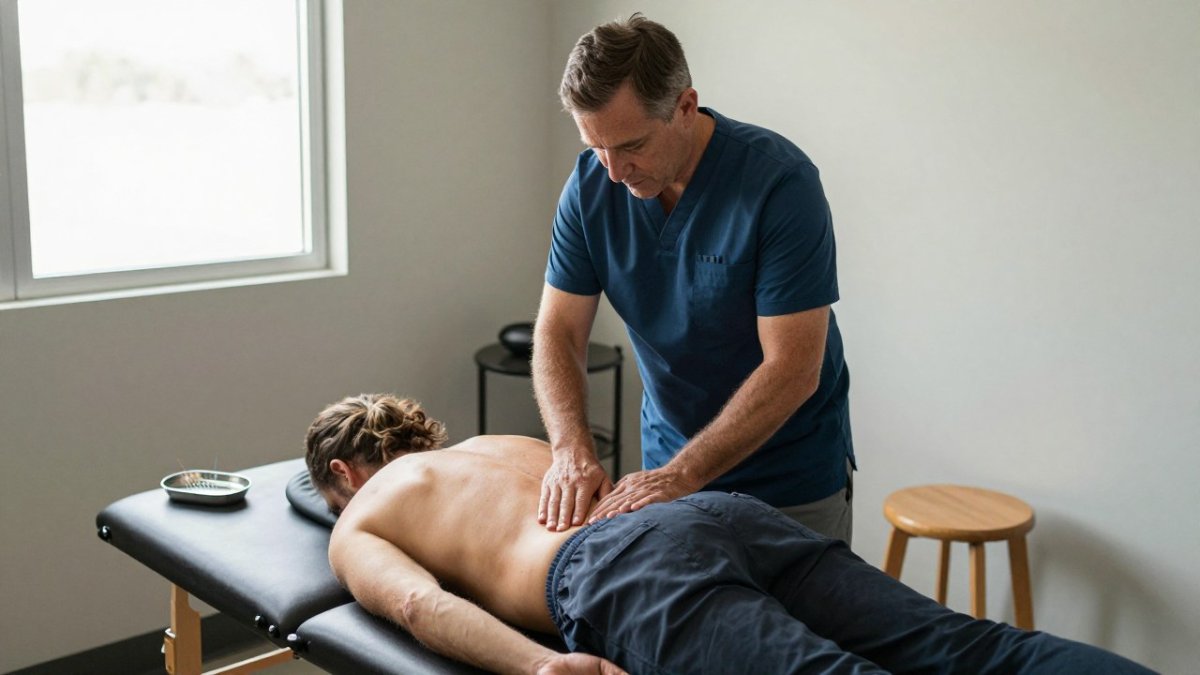
Chiropractic care for back pain works best as part of a coordinated plan, not a standalone routine. Gentle adjustments restore joint motion, and when your therapist and physician know what is being done, the plan stays consistent.
Moore Chiropractic provides gentle chiropractic techniques and personalized care plans.
Watch out: repeated adjustments without any strengthening work rarely hold. If your plan never includes exercise or movement retraining, ask why.
If you are weighing options, this comparison of chiropractic and physical therapy covers efficacy, timelines, and costs.
How to Evaluate a Multidisciplinary Pain Program in San Antonio
Evaluating a program in San Antonio comes down to more than whether it lists several specialties on its website. Use this framework to separate genuine coordinated care from a single service with a broader label.
The Five-Question Checklist
Ask these before you commit to care:
- Does the team include more than one discipline, and do members actually communicate, through shared notes, case conferences, or a care coordinator?
- Is there a written treatment plan with measurable goals and a review date?
- Does the program teach self-management skills, or only provide in-clinic treatment?
- Are red flags screened at the first visit?
- Is the provider willing to say when care is not appropriate for you?
A program that cannot answer these clearly is not multidisciplinary. It is a single service with a broader label.
How to Navigate Coordinated Care in San Antonio
Access in San Antonio usually starts with a primary care provider, who can screen for red flags, order imaging only when needed, and refer to physical therapy, behavioral health, or a pain specialist.
When you call a clinic, ask three practical questions: who will coordinate my care, how will my other providers be kept informed, and what is the expected timeline before the first review? A clinic that cannot name a coordinator or a review date is unlikely to deliver coordinated care.
Insurance, Costs, and Access
Coverage varies by plan, and no clinic should quote figures it cannot verify. Ask each provider for a written estimate and confirm benefits directly with your insurer before starting. In Texas, common practical questions include whether physical therapy visits are capped per year, whether chiropractic care requires a referral, and whether behavioral health is covered under the same plan or a separate carve-out.
If a claim is denied, you have appeal rights. This guide on how to appeal a denied pain management insurance claim in Texas walks through the steps.
Measuring Progress and Setting Expectations
Progress should be measured, not assumed. Track physical function, pain interference with daily tasks, and how far you can walk or sit before symptoms build. Many people see meaningful change over several weeks rather than days, and setbacks are normal. A plan that adjusts based on your measurements beats one that never changes.
Seek urgent care for new leg weakness, numbness in the groin area, loss of bladder or bowel control, or pain following a major injury. Those signs need same-day medical evaluation.
Measuring Progress and Knowing When to Seek Urgent Care
Progress should be measured, not assumed. Track physical function, pain interference with daily tasks, and how far you can walk or sit before symptoms build.
Set expectations early. Many people see meaningful change over several weeks rather than days, and setbacks are normal. A plan that adjusts based on your measurements beats one that never changes.
Seek urgent care for new leg weakness, numbness in the groin area, loss of bladder or bowel control, or pain following a major injury. Those signs need same-day medical evaluation.
Booking Your Complimentary Evaluation at Moore Chiropractic
Moore Chiropractic offers a complimentary evaluation and consultation for new patients.
You get gentle techniques and a personalized plan.
Get started with Moore Chiropractic and take the first step toward lasting relief. Review our back pain treatment in San Antonio services to see how we can help.
Back pain that keeps returning deserves a coordinated look rather than another isolated appointment. Moore Chiropractic offers gentle chiropractic techniques, personalized care plans, and a complimentary evaluation so you can understand your options before committing to anything. Get started with Moore Chiropractic and build a plan around your goals.
Frequently Asked Questions
What treatments may be included in a multidisciplinary back pain plan?
A coordinated plan usually combines several approaches rather than relying on one. Common elements include a thorough pain assessment, physical therapy and rehabilitation, medication management, behavioral health support such as pain coping skills training, and interventional procedures when appropriate. Chiropractic care and patient education often round out the plan. Your primary care provider or pain specialist coordinates the team so each piece reinforces the others, and treatment goals focus on functional outcomes like walking, sitting, and sleeping better rather than pain relief alone.
How does multidisciplinary treatment help with chronic back pain?
Chronic back pain rarely has a single cause, so a multidisciplinary pain team addresses the physical, psychological, and social factors together. A biopsychosocial approach can improve physical function and quality of life while reducing pain-related disability. Because the team shares one treatment plan, you avoid duplicated tests and conflicting advice. Progress is measured through functional outcomes, not just pain scores, which gives you a clearer picture of whether the plan is working.
How do I choose a multidisciplinary pain program in San Antonio?
Look for a program that explains its assessment process up front, names the specialists involved, and sets measurable treatment goals with you. Ask how the team communicates, whether they accept your insurance, and what a typical visit schedule looks like. Moore Chiropractic offers a complimentary evaluation and consultation for new patients.
What’s the worst thing you can do for back pain?
Long stretches of bed rest and avoiding all movement usually make chronic low back pain worse by weakening supporting muscles and stiffening joints. Pushing through sharp pain or ignoring red flags such as numbness, weakness, or loss of bladder control is equally risky. Self-treating for weeks without an assessment can also delay the right care. A better path is early evaluation, gentle activity within comfort, and a coordinated plan that includes physical therapy and self-management skills.