Last Updated: November 19, 2026
Quick Summary
Gentle, slow stretches such as side-lying hip movements, supported hip flexor stretches, and seated pelvic circles may ease round ligament pain during pregnancy. Stop any stretch that causes sharp pain, and check with your provider before starting a routine.
- Hold each stretch for 20 to 30 seconds and repeat 2 to 3 times per side.
- Round ligament pain is most common in the second trimester, when the uterus begins to rise.
- Quick movements like standing up, rolling over, or coughing often trigger the sharp pinch.
- Skip any stretch that causes sharp pain, numbness, tingling, or pain that lingers after you finish.
- Contact your provider right away for bleeding, fluid leaking, regular cramping, or fever.
Table of Contents
- What Round Ligament Pain Is and Where You Feel It
- Common Causes and When Round Ligament Pain Usually Starts
- Pregnancy-Safe Stretches for Round Ligament Pain by Trimester
- Step-by-Step Stretch Instructions and Modifications
- Printable Round Ligament Pain Stretches PDF Routine
- Red Flags and When to See Your Provider
- Booking a Prenatal Evaluation in San Antonio
- Frequently Asked Questions
What Round Ligament Pain Is and Where You Feel It
Round ligament pain is a sharp or aching discomfort felt in the lower abdomen or groin, often on one side, during pregnancy (the NHS). The round ligaments are two cords of tissue that support the uterus and stretch as it grows. When they tighten or stretch quickly, they can cause that familiar pinch. (Source: American College of Obstetricians and Gynecologists)
Most women feel it on the front of the hips, low in the belly, or in the inner thigh. Many describe it as a brief stab when they stand up, roll over in bed, or cough. It usually passes within seconds or a minute.
The first step is knowing what your body is doing. Pelvic and hip pain can overlap with round ligament pain, so a clear description of where and when it happens helps your provider sort things out.
Common locations include:
- The lower belly, usually on one side
- The front of the hip or groin
- The inner thigh
- Occasionally the lower back, which can make it harder to tell apart from other pain
Common Causes and When Round Ligament Pain Usually Starts
Round ligament pain happens when the uterus grows and pulls on the ligaments that anchor it to the pelvis. Quick movements, sneezing, laughing, and getting up from a chair can all trigger a brief pull.
Many women first notice it in the second trimester, when the uterus starts to rise out of the pelvis. It can continue into the third trimester as the baby grows. Some women feel it earlier, and some never feel it at all.
Several everyday factors can make it feel worse:
- Standing or walking for long periods
- Rolling over quickly in bed
- Sudden twisting or bending
- Carrying a heavy load on one hip
Understanding these patterns helps you move more carefully. Small changes, like pausing before standing up, often reduce how often the pinch shows up.
Pregnancy-Safe Stretches for Round Ligament Pain by Trimester
Gentle stretching may ease tension around the hips and pelvis. Explore the full set of gentle prenatal stretch routines for hip and lower body discomfort. Stretches should feel comfortable and never sharp.
First Trimester Stretches
Round ligament pain is less common this early, but gentle movement keeps the hips and pelvis loose. A simple cat-cow stretch on hands and knees and standing hip circles are good options. Keep each movement small and slow.
Second Trimester Stretches
This is when round ligament pain most often starts. Side-lying stretches and a supported hip flexor stretch work well here. Use a pillow between the knees for side-lying positions to keep the pelvis in line.
Pelvic tilts while lying on your back can also help. Keep the back relaxed, and skip this position if it makes you dizzy or uncomfortable.
Third Trimester Stretches
As the belly grows, lying flat on the back may feel uncomfortable. Side-lying positions and seated stretches become more useful. A birthing ball can support gentle pelvic circles while you sit.
Stop any stretch that causes pain that lingers after you finish. Discuss ongoing discomfort with your provider.
Step-by-Step Stretch Instructions and Modifications
Follow these steps slowly and breathe steadily throughout. A good rule is to inhale through the nose and exhale through the mouth, and to keep your jaw and shoulders relaxed. Hold each stretch for 20 to 30 seconds, repeat 2 to 3 times per side, and rest 30 to 60 seconds between moves. Stop any stretch that causes sharp pain, numbness, tingling, or pain that lingers after you finish.

-
Side-lying hip stretch: Lie on your left side with a pillow between your knees and your head supported. Bend both knees to about 90 degrees. Keeping your pelvis still, gently lift your top knee a few inches, then lower it. Move slowly for 8 to 10 slow repetitions, then switch sides. This is a gentle mobility drill, not a forceful stretch.
-
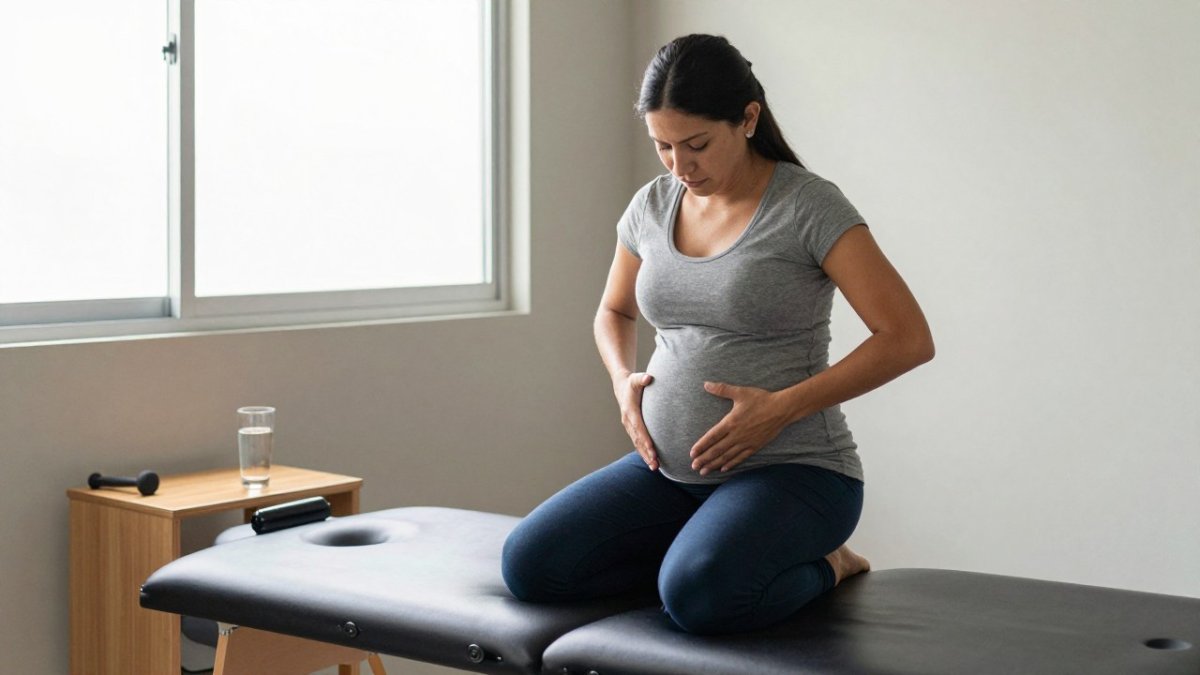
Supported hip flexor stretch: Place a folded towel or cushion under your back knee and kneel on it with the other foot forward, both knees bent to about 90 degrees. Tuck your pelvis slightly and lean forward until you feel a gentle stretch at the front of the back hip. Hold 20 to 30 seconds, breathe, and switch sides. Keep the movement small. (Source: is chiropractic safe during pregnancy)
-
Seated pelvic circles: Sit on a birthing ball or firm chair with feet flat and hip-width apart. Place your hands on your hips and make small, slow circles in one direction for 30 seconds, then reverse. Keep the circles small enough that your belly does not bounce.
-
Side bend: Stand with feet hip-width apart and one hand on a wall or chair for balance. Reach the opposite arm overhead and lean gently to the side until you feel a stretch along your waist. Hold 20 to 30 seconds, breathe, and switch sides. Do not twist or bounce.
-
Pelvic tilt: Lie on your back with knees bent and feet flat, or sit on a firm chair if lying flat is uncomfortable. Gently flatten your lower back toward the floor or chair by tilting your pelvis, hold 5 seconds, then release. Repeat 8 to 10 times. Skip this position if it makes you dizzy or short of breath.
Modifications for different stages and mobility needs:
- First trimester: Keep ranges small and focus on gentle mobility rather than deep stretching.
- Second and third trimester: Use a wall, chair, or ball for balance, and add a pillow under the belly or hips for support.
- Limited mobility or discomfort kneeling: Do the hip flexor stretch seated at the edge of a chair by sliding one foot back and gently tucking the pelvis, or replace floor moves with seated pelvic circles and side bends.
- Discomfort lying flat: Choose side-lying, seated, or standing versions and avoid long periods on your back.
Watch out: If a stretch causes a sharp pinch in the groin or lower belly, shorten the range of motion or skip that move and mention it to your provider at your next visit.
The article’s key stretch details are easier to scan side by side.
| Stretch | Hold or reps | Key cue |
|---|---|---|
| Side-lying hip stretch | 8 to 10 slow reps per side | Keep pelvis still |
| Supported hip flexor stretch | 20 to 30 seconds per side | Keep movement small |
| Seated pelvic circles | 30 seconds each direction | Circles small enough to avoid bouncing |
| Side bend | 20 to 30 seconds per side | Do not twist or bounce |
| Pelvic tilt | 8 to 10 reps, 5-second hold | Skip if dizzy or short of breath |
Printable Round Ligament Pain Stretches PDF Routine
A short printable routine helps you repeat these stretches at home. Print a one-page checklist, pair it with a timer, and keep it near your mat or favorite chair.
Simple daily routine:
- Side-lying hip stretch, 30 seconds each side
- Supported hip flexor stretch, 30 seconds each side
- Seated pelvic circles, 1 minute
- Side bend, 20 seconds each side
Check off each step as you finish it. Stop if any movement causes sharp pain.
Red Flags and When to See Your Provider
Round ligament pain is common and usually harmless, but it helps to know what is typical and what is not. Typical round ligament discomfort is brief, often lasting seconds to a minute, is linked to a specific movement like standing up, rolling over, or coughing, and eases when you change position or rest. It is often felt on one side of the lower belly or groin and does not usually come with fever, bleeding, or regular cramping.
Contact your doctor or midwife right away if you have:
- Bleeding or fluid leaking from the vagina
- Pain that is severe, constant, or getting worse instead of easing with rest
- Pain with fever, chills, or painful urination
- Contractions, regular cramping, or pressure in the pelvis
- Swelling, redness, or pain in one calf
- Reduced movement or changes in your baby’s movement
- Dizziness, fainting, or severe headache
How round ligament pain differs from other pelvic pain: Round ligament pain is usually a brief, sharp pull tied to a movement. Pelvic girdle pain often feels like a deeper ache over the pubic bone or across the back of the pelvis, may be worse with walking or standing on one leg, and can linger. Other causes, such as urinary tract infections or preterm labor, can feel different and need different assessment. Only a qualified provider can assess your specific situation.
What to tell your provider: Note where the pain is, what triggers it, how long it lasts, and whether it comes with any of the red-flag symptoms above. Bring that list to your appointment so your provider can sort out whether it is typical round ligament pain or something that needs a closer look. This section offers general information, not a diagnosis.
Booking a Prenatal Evaluation in San Antonio
If round ligament pain or pelvic discomfort keeps getting in the way of daily life, a prenatal evaluation can help. Consider a chiropractic care during pregnancy in San Antonio consultation to discuss your symptoms.
Before booking, you may want to read Chiropractic Care and Pregnancy: What San Antonio Moms Should Know to understand what prenatal chiropractic involves. Check with your OB or midwife first, and bring a list of your symptoms to your appointment.
Frequently Asked Questions
Does stretching help round ligament pain during pregnancy?
Gentle, slow stretching often eases round ligament pain for many people because it relaxes the muscles around the hips and lower abdomen that can tighten and pull on the ligaments. Stretches such as side-lying positions, hip flexor stretches and pelvic tilts are commonly used. Move slowly, stay within a comfortable range, and stop if the pain sharpens or new symptoms appear. Stretching may reduce discomfort but does not treat the underlying cause, so check with your prenatal provider before starting a routine.
Is round ligament pain normal in the third trimester of pregnancy?
Yes, round ligament pain can continue into the third trimester as the uterus grows and the ligaments stretch to support it. It is usually a sharp or pulling sensation on one or both sides of the lower abdomen or groin that comes on with sudden movements such as standing up quickly or rolling over in bed. Pain that is severe, constant, or comes with bleeding, fever, contractions, or fluid leakage is not typical and should be evaluated by your provider right away.
Which stretches are safe for round ligament pain in the second trimester?
Many people find relief in second trimester stretches such as the modified side bend, a gentle kneeling hip flexor stretch with support, and seated pelvic tilts. Keep movements slow, avoid lying flat on your back for long periods, and use pillows for support. Avoid deep twisting or stretches that cause pinching. Because needs vary, confirm which exercises suit your pregnancy with your midwife, doctor or physical therapist.
When should you call your pregnancy care provider about round ligament pain?
Call your provider if the pain is severe, does not ease with rest, or appears with warning signs such as vaginal bleeding, fluid leaking, regular contractions, fever, painful urination, calf swelling, or chest pain. These symptoms can indicate conditions that need prompt care. If you are unsure whether your pain is round ligament pain or something else, a quick call to your provider is always appropriate.