

Last Updated: October 31, 2026
Quick Summary
For most healthy older adults, chiropractic care is generally considered low risk when a qualified chiropractor uses a gentle, individualized approach. Whether chiropractic care safe for you depends on your health history, the technique used, and the provider’s skill.
- Review all current medications, especially blood thinners, before starting treatment.
- Osteoporosis is the key safety concern, so disclose any diagnosis or DEXA results before the first adjustment.
- Ask the provider to avoid rotational and extension thrusts in the thoracic and lumbar spine if bone density is low.
- Mild soreness after an adjustment is the most common side effect and usually fades within a day or two.
- Check Medicare.gov or your plan before booking, since chiropractic coverage rules can change.
Table of Contents
- How Safe Is Chiropractic Care for Older Adults?
- Chiropractic Care and Osteoporosis: What Changes for Older Bones
- Age-Related Changes in the Spine and Joints That Affect Treatment
- Gentle Chiropractic Techniques for Seniors and How They Differ
- Questions to Ask a Chiropractor Before Treatment
- Medicare Coverage for Chiropractic Care: What to Check
- Booking a Senior-Focused Evaluation at Moore Chiropractic in San Antonio
- Frequently Asked Questions
How Safe Is Chiropractic Care for Older Adults?
Is chiropractic care safe for seniors? For most healthy older adults, a qualified chiropractor using a gentle, individualized approach is generally considered low risk, but whether chiropractic care safe for an individual depends heavily on health history, the specific technique used, and the skill of the provider. For a deeper, dedicated look at this question, read are chiropractic adjustments safe for seniors.
Age changes how the body responds to treatment. Bones can be thinner, joints can be stiffer, and blood vessels in the neck can be more fragile. These factors don’t rule out chiropractic care, but they do call for more careful assessment.
Common precautions for older adults include:
- Reviewing all current medications, especially blood thinners
- Noting any history of fractures, osteoporosis, or spinal surgery
- Checking for conditions like advanced arthritis or spinal stenosis
- Flagging any recent falls, dizziness, or unexplained weight loss
Risks are real but uncommon. Mild soreness after an adjustment is the most frequently reported side effect, and it usually fades within a day or two. Serious complications are rare, but they are the reason a full health history matters. Ask any provider how they screen for them before you book.
Chiropractic Care and Osteoporosis: What Changes for Older Bones
Osteoporosis is the single most important safety consideration when an older adult considers spinal manipulation, because low bone mineral density changes how much force a vertebra can tolerate before it fractures. The condition is common in older adults, the National Osteoporosis Foundation estimates about 10 million Americans have osteoporosis and another 44 million have low bone mass, so a chiropractor who treats seniors should be screening for it routinely, not only when a patient volunteers the diagnosis (54 Million Americans Affected by Osteoporosis and Low Bone Mass).
Why force direction matters more than force size. A high-velocity, low-amplitude (HVLA) thrust delivers a rapid rotational or extension load to a spinal segment. In a bone with reduced density, that same load can exceed the fracture threshold even when the practitioner considers the thrust “light.” This is why many clinicians change the direction and positioning of the adjustment, not just the amplitude.
Common modifications for patients with known or suspected osteoporosis:
- Avoid rotational and extension thrusts in the thoracic and lumbar spine, where compression fractures most often occur; substitute prone or side-lying mobilization.
- Use instrument-assisted or table-based low-force methods (for example, a handheld spring-loaded instrument or flexion-distraction) that apply controlled, measured force rather than a manual thrust.
- Skip high-velocity cervical manipulation in patients with significant bone loss, and use gentle cervical mobilization or soft-tissue work instead.
- Screen for red flags before any hands-on care: a prior fragility fracture, long-term corticosteroid use, a DEXA T-score of −2.5 or lower, height loss of more than 1.5 inches, or a new onset of mid-back pain after a minor fall.
What to bring to the first visit. If you have had a DEXA scan, bring the report, not just the diagnosis. The T-score and the presence of prior vertebral fractures tell the chiropractor far more than the word “osteoporosis” does. If you have never been tested for bone density, ask your primary care clinician whether a DEXA scan is appropriate before starting spinal manipulation.
A diagnosis of osteoporosis is not an automatic reason to avoid chiropractic care, but it is a reason to disclose it before the first adjustment and to ask specifically which techniques the provider will avoid. A provider who cannot explain the modification in plain language is a reason to get a second opinion.
Osteoporosis changes how a chiropractor should approach spinal treatment, and the article lists specific modifications and red flags to screen for.
| Modification or red flag | Why it matters | Note |
|---|---|---|
| Avoid rotational and extension thrusts | Compression fractures most often occur in the thoracic and lumbar spine | Substitute prone or side-lying mobilization |
| Use instrument-assisted or flexion-distraction | Applies controlled, measured force instead of a manual thrust | Low-force alternative |
| Skip high-velocity cervical manipulation | Significant bone loss raises risk | Use gentle mobilization or soft-tissue work |
| Prior fragility fracture | Red flag before any hands-on care | Screen before treatment |
| DEXA T-score of −2.5 or lower | Indicates low bone mineral density | Bring the full DEXA report |
| Height loss over 1.5 inches | Possible sign of vertebral fracture | Red flag before treatment |
| New mid-back pain after a minor fall | Possible sign of vertebral fracture | Red flag before treatment |
| Long-term corticosteroid use | Weakens bone | Red flag before treatment |
Age-Related Changes in the Spine and Joints That Affect Treatment
Spinal discs lose water over time, joints develop arthritis, and ligaments stiffen. Learn more about these changes in your neck in understanding cervical spine health and neck pain. These changes shape how a chiropractor plans care. Stiff joints can call for a different approach, and some conditions can make certain movements unsafe.
Imaging like X-rays or MRI can reveal these changes. Ask your chiropractor whether recent scans are needed before starting treatment.
Gentle Chiropractic Techniques for Seniors and How They Differ
Not every chiropractic approach involves a forceful twist. You can learn what gentle chiropractic means and whether low-force options suit you. Gentle chiropractic techniques can be used with older patients, and the right option depends on the individual. Compare the main methods in understanding the different types of chiropractic techniques.
Each technique suits different conditions. Ask which method fits your health history and what results to expect. Learn about the techniques local clinics use in understanding chiropractic techniques for San Antonio residents.
Questions to Ask a Chiropractor Before Treatment
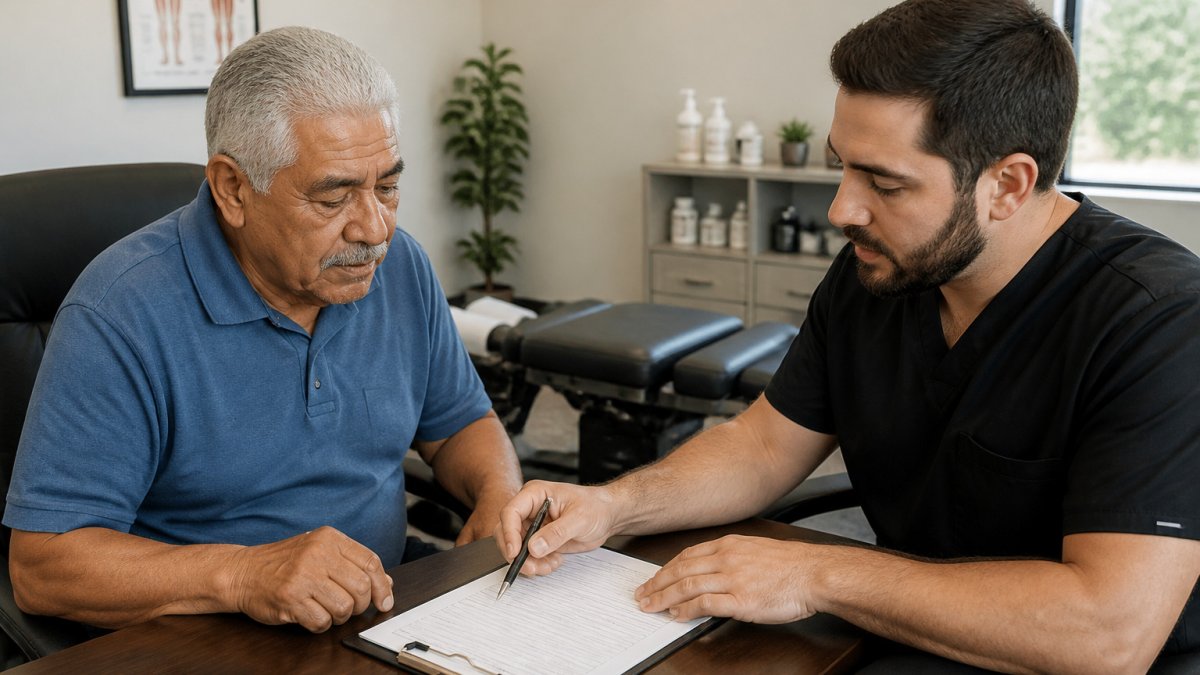
A short list of questions is only useful if you know what a strong answer sounds like. The questions below are grouped by what they are actually testing, screening, technique, coordination, and expectations, so you can judge the response rather than just collect it.
On screening and contraindications
- “How do you screen older adults for conditions that make manipulation unsafe?” A strong answer names specific conditions, osteoporosis, prior vertebral fracture, spinal cord compression, cauda equina syndrome, severe spinal stenosis, unstable cervical spine, or a history of stroke, and describes a hands-on and history-based exam, not just a questionnaire.
- “What would make you decline to adjust me, or refer me out?” A provider who cannot name a single situation in which they would not adjust is not screening carefully.
- “How do you factor in my medications?” Blood thinners (warfarin, apixaban, rivaroxaban) raise bleeding risk with soft-tissue work and some injections; ask how the provider accounts for them.
On technique and informed consent
- “Which specific techniques would you use for me, and why?” Ask them to name the method, HVLA, mobilization, instrument-assisted, flexion-distraction, and to explain the trade-off. A provider should be able to describe a lower-force alternative and let you choose it.
- “Can I consent to one technique and decline another?” Informed consent for chiropractic care is not all-or-nothing; you can agree to soft-tissue work and mobilization while declining a cervical thrust.
- “What are the known risks of the technique you are recommending, and how common are they?” Expect a plain-language answer that distinguishes common mild soreness from rare serious events.
On coordination with your other clinicians
- “Will you send a note to my primary care doctor, and will you review records I bring?” Care coordination matters most for seniors with multiple conditions; ask whether the office will share findings and whether they will accept imaging and notes from your physician.
- “If I need imaging, who orders it and who reads it?” Some chiropractic offices order X-rays in-house; ask whether a radiologist will review them and how the results will be shared with your primary care clinician.
On credentials and accessibility
- “Are you licensed in this state, and what is your training in geriatric care?” You can verify a Texas license through the Texas Board of Chiropractic Examiners. Ask whether the provider has taken continuing education focused on older adults.
- “Is the office accessible, parking, entrance, exam tables that lower, and enough time for a slower visit?” For a senior with mobility limitations, these practical details affect safety as much as technique does.
On expectations and cost
- “How many visits do you expect, and how will we measure whether it is working?” A realistic plan names a review point, often after a few visits, and a measure such as pain score or range of motion, rather than an open-ended schedule.
- “What will this cost me out of pocket, and do you bill Medicare?” Medicare Part B covers chiropractic manual manipulation of the spine to correct a subluxation but not routine maintenance visits; ask the office to confirm in writing what your plan covers before booking (Coverage For Chiropractic Services).
You do not need to ask every question on this list. Pick the two or three that match your biggest concern, bone health, a prior surgery, a blood thinner, or cost, and judge the provider on whether the answer is specific, plain, and willing to say “I don’t know, let me check.”
Medicare Coverage for Chiropractic Care: What to Check
Medicare coverage for chiropractic care has specific rules and limits that can change, so check the official source at Medicare.gov or call your plan before booking. Supplemental Medicare Advantage plans may offer additional chiropractic benefits, so review your policy carefully.
Booking a Senior-Focused Evaluation at Moore Chiropractic in San Antonio
If you are an older adult in San Antonio wondering whether chiropractic care is right for you, a senior-focused evaluation is a practical first step. At Moore Chiropractic, we can discuss your health history and concerns during an evaluation. Our complimentary evaluation and consultation give you a chance to ask questions. Contact us to schedule your visit and learn whether chiropractic care is a safe choice for you.
Frequently Asked Questions
Is a chiropractor good for you?
A chiropractor can be a reasonable option for some people with neck or back pain, particularly for musculoskeletal complaints. Whether it suits you depends on your health history, current medications, and the specific problem. Chiropractic care is generally considered low risk for many adults, but it is not appropriate for everyone. Ask your primary care provider whether chiropractic fits your situation, and choose a chiropractor who performs a documented screening before any treatment begins.
What chiropractic does Medicare cover for seniors?
Medicare coverage for chiropractic services has specific rules and limits that can change, so confirm current details on medicare.gov or with your plan before scheduling. A chiropractor can explain what will and will not be billed.
Can seniors with osteoporosis get chiropractic adjustments?
Osteoporosis reduces bone density and raises fracture risk, so it changes how gentle a provider needs to be. Osteoporosis is a factor a chiropractor should know about before any spinal treatment. This decision should be made after an individual evaluation and, where appropriate, coordination with the patient’s physician.
What should older adults tell a chiropractor before treatment?
Share a complete health history, including osteoporosis, prior fractures, cancer, blood-thinning medications, heart or vascular conditions, previous spine surgery, and any recent falls or injuries. Also list all prescriptions and supplements. This information helps the chiropractor identify contraindications and decide whether treatment is safe, which is the core purpose of the initial screening.