
Last Updated: November 2, 2026
Quick Summary
Is chiropractic treatment effective for nerve pain? It may help some nerve-related symptoms, especially pinched nerves caused by mechanical pressure from the spine, but results depend on the cause and severity. For nerve damage from conditions like diabetes, chiropractic care works best alongside medical treatment, not in place of it.
- Chiropractic care may reduce pain and restore movement for pinched nerves caused by spinal pressure.
- Evidence is weaker for peripheral neuropathy, since adjustments cannot repair damaged nerve fibers.
- Confirming nerve damage often requires imaging or nerve testing such as an MRI or nerve conduction study.
- Loss of bladder or bowel control, or saddle numbness, needs emergency care right away.
- Symptoms that worsen steadily or spread in both feet or hands should be evaluated medically first.
Table of Contents
- What Nerve Pain Is and What Causes It
- How Chiropractic Care May Affect Nerve Pain
- Can a Chiropractor Diagnose Nerve Damage?
- Chiropractor for Pinched Nerve: What to Expect at Your Visit
- Chiropractic Care for Neuropathy: What the Evidence Shows
- How Long Does Chiropractic Care Take to Help a Pinched Nerve?
- Red Flags and Conditions That Need Medical Care First
- Booking a Nerve Pain Evaluation at Moore Chiropractic in San Antonio
- Frequently Asked Questions
Nerve pain can make everyday tasks hard, from sleeping through the night to sitting at a desk. Many people in San Antonio wonder whether chiropractic treatment is effective for nerve pain, and whether it is worth trying before or alongside other care. The short answer is that chiropractic care may help some nerve-related symptoms, but results depend on the cause, the severity of the problem, and whether a medical issue needs attention first. This guide from Moore Chiropractic explains what nerve pain is, how chiropractic care may affect it, and when you should get checked by a medical professional before starting treatment. (Source: National Institute of Neurological Disorders and Stroke (NINDS))
What Nerve Pain Is and What Causes It
Nerve pain happens when a nerve is irritated, compressed, or damaged. Doctors often describe it as a sharp, burning, shooting, or tingling sensation that does not match a simple muscle ache.
Common causes include:
- Disc problems that press on spinal nerves
- Repetitive strain from posture or work habits
- Injuries to the neck or back
- Diabetes and other conditions that affect nerve health
Pinched nerves, neuropathy, and sciatica compared
These terms are related but not the same. A pinched nerve usually involves pressure from nearby tissue, such as a disc or bone. Neuropathy is a broader term for nerve damage, often felt as numbness or tingling in the hands or feet. Sciatica is pain that travels along the sciatic nerve, usually from the lower back into the leg.
How Chiropractic Care May Affect Nerve Pain
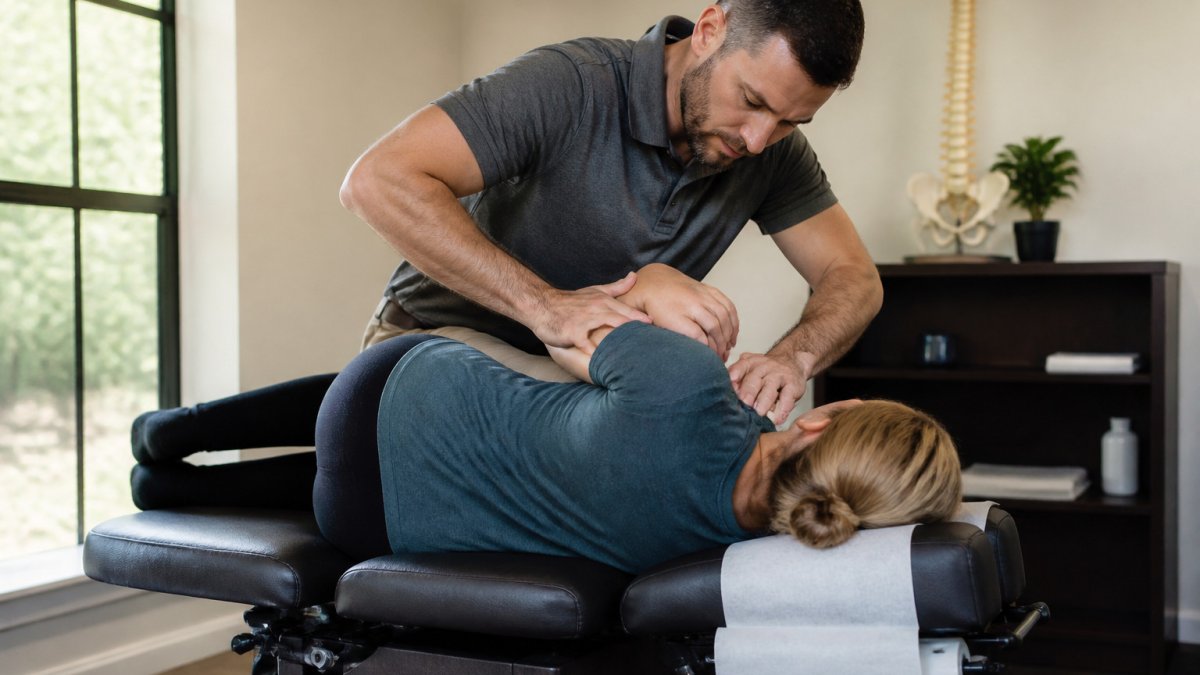
Chiropractic care focuses on the spine and joints. Chiropractors use manual adjustments to improve spinal alignment and movement. The goal is to reduce pressure on irritated nerves and ease muscle tension around them.

Possible benefits may include:
- Less pain and stiffness
- Better range of motion
- Improved posture and movement
- Symptom relief for some pinched nerve cases
Chiropractic care is not a cure for every type of nerve damage. It may work best for mechanical problems, such as nerves irritated by spinal joints or muscles. For nerve damage caused by diabetes or other medical conditions, chiropractic care usually works alongside medical treatment, not in place of it.
Can a Chiropractor Diagnose Nerve Damage?
A chiropractor can perform a physical exam, check reflexes, test strength, and review your history. These steps can help identify whether a nerve may be irritated.
However, confirming nerve damage often requires imaging or nerve testing, such as an MRI or nerve conduction study. A chiropractor may refer you to a physician for these tests if needed.
Chiropractor for Pinched Nerve: What to Expect at Your Visit
Your first visit usually includes a health history, a physical exam, and a discussion of your symptoms. The chiropractor will explain what they find and whether chiropractic care seems suitable.
If care is recommended, you can expect:
- A clear plan with goals and timing
- Gentle adjustments or other hands-on methods
- Advice on posture, movement, and daily habits
- Regular check-ins to track your progress
At Moore Chiropractic, the first step is a complimentary evaluation so you can learn whether care is a good fit before committing to treatment.
Chiropractic Care for Neuropathy: What the Evidence Shows
Most ranking articles blur two very different problems under the word “nerve pain,” and that blurring is why the effectiveness question gets answered badly. The evidence picture looks different depending on which one you have.
Nerve-root compression (radiculopathy and pinched nerve)
This is nerve pain caused by mechanical pressure, a herniated disc, bone spur, or narrowed space in the spine pressing on a nerve root, producing shooting pain, numbness, or weakness down an arm or leg. For this category, the evidence is modest but more supportive. Clinical guidelines from groups such as the American College of Physicians list spinal manipulation, the core chiropractic adjustment, among the noninvasive options for acute and chronic low back pain (American College of Physicians issues guideline for treating nonradicular low back pain). What the research does not show is that adjustments “release” or “realign” a nerve, or that they reverse a disc herniation. The realistic goal is reducing pain and restoring movement so the irritated nerve can settle.
Peripheral neuropathy
This is a different condition: damage to nerves themselves, most often in the feet and hands, and most commonly caused by diabetes in the United States. Here the evidence for chiropractic adjustment as a treatment for the neuropathy itself is thin. A chiropractor cannot repair damaged nerve fibers with a spinal adjustment, and no credible body of research shows that adjustments reverse diabetic or chemotherapy-related neuropathy. What chiropractic care can reasonably do is address coexisting musculoskeletal problems, stiff joints, muscle tension, altered gait, that make neuropathy symptoms feel worse, and support the parts of care that do have evidence: blood sugar control, foot care, exercise, and medications your physician prescribes. If a provider promises to cure or reverse neuropathy, that is a reason to get a second opinion.
What is genuinely uncertain
- Whether regular adjustments change long-term outcomes versus short-term symptom relief
- How much of reported improvement is the adjustment versus natural recovery, activity change, or expectation
- Which patients are most likely to respond, since most studies are small and mix different nerve conditions together
A fair summary: chiropractic care is a reasonable, low-risk component of care for some mechanical nerve-root problems, a supportive add-on at best for peripheral neuropathy, and never a substitute for medical management of the underlying disease. If you are weighing chiropractic for sciatica, learn when a chiropractor is the right choice and what gentle care looks like. Ask any provider to explain which category your symptoms fall into before you agree to a treatment plan.
American College of Physicians low back pain guideline
The evidence differs by type of nerve problem, as summarised below.
| Condition | Cause | What chiropractic can realistically do |
|---|---|---|
| Nerve-root compression (radiculopathy, pinched nerve) | Mechanical pressure from a herniated disc, bone spur, or narrowed spine | Reduce pain and restore movement; evidence modest but more supportive |
| Peripheral neuropathy | Damage to nerves themselves, most often from diabetes | Address coexisting joint or muscle problems; cannot repair nerve damage |
| Spinal manipulation (guidelines) | Listed among noninvasive options for low back pain | Recommended by American College of Physicians for back pain |
| Uncertain areas | Long-term outcomes, placebo effects, which patients respond | Evidence remains limited; most studies are small |
How Long Does Chiropractic Care Take to Help a Pinched Nerve?
Timelines differ from person to person. Acute symptoms may ease faster than long-standing nerve problems. A chiropractor will usually reassess your progress after a set number of visits.
If you see no improvement after a reasonable trial, your provider should discuss other options, including referral for medical care.
Red Flags and Conditions That Need Medical Care First
Most nerve pain is not an emergency, but a small set of symptoms means the problem needs a physician now, not a course of adjustments. The distinction matters because a delayed diagnosis of a serious nerve problem can lead to permanent weakness or loss of function that no hands-on treatment can undo.
Seek emergency care immediately
Call 911 or go to an emergency department if you have:
- Loss of bladder or bowel control, or numbness in the groin, inner thighs, or buttocks that makes it hard to feel when you need to go. This pattern, saddle numbness plus bowel or bladder changes, can signal cauda equina syndrome, a compression of the nerve bundle at the base of the spine that is a surgical emergency. Time matters: outcomes are best when it is treated within about 24 to 48 hours of symptom onset.
- Sudden or rapidly progressive weakness in an arm or leg, such as a foot that drags or a hand that cannot grip. Progressive weakness is a sign of significant nerve compromise and needs prompt evaluation.
- Severe pain after a fall, car crash, or other trauma, especially with fever, or with new back pain in someone with a history of cancer or unexplained weight loss.
- Fever with back or neck pain, or neck pain with confusion, which can indicate infection.
See a physician promptly (within days, not weeks)
- Weakness or numbness that is steadily worsening rather than fluctuating
- Pain that follows a dermatome, a stripe of burning or shooting pain wrapping around the ribs or down one leg, with a new rash, which can indicate shingles
- New nerve symptoms in both feet or hands that are spreading upward, particularly if you have diabetes
- Symptoms that began after starting a new medication or after chemotherapy
What this means for chiropractic care
For these symptoms, a medical evaluation comes first. A chiropractor who screens properly will refer you out rather than adjust you, and a provider who is willing to treat through saddle numbness, progressive weakness, or fever is a reason to leave. Once a physician has ruled out an emergency and identified the cause, chiropractic care can be reconsidered as part of the plan.
Watch out: numbness or tingling that starts in both feet and creeps upward over weeks is a common early pattern of peripheral neuropathy, not a spinal problem, and it should be evaluated medically before any treatment plan is started.
Booking a Nerve Pain Evaluation at Moore Chiropractic in San Antonio
If you live in San Antonio and want to know whether chiropractic care may help your nerve pain, a consultation is a practical next step. The team at Moore Chiropractic can review your symptoms, explain what they find, and tell you whether chiropractic is a good fit.
Pricing and insurance details vary, so contact Moore Chiropractic directly for current information. Call the office or visit the website to schedule your complimentary evaluation.
Frequently Asked Questions
Can a chiropractor make a pinched nerve worse?
No treatment is risk-free, and you should discuss the risks of any care with a qualified professional. Mild soreness after an adjustment is the most common reported effect. Patients with fractures, severe osteoporosis, progressive weakness, loss of bladder or bowel control, or a recent serious injury need medical evaluation before any spinal manipulation.
Should you go to a chiropractor for nerve pain?
A chiropractor is a reasonable option for some nerve pain, particularly pain linked to spinal alignment, neck or low back problems, and nerve irritation from muscle tension or joint restriction. Nerve pain can also come from diabetes, infections, medication effects, or serious spinal conditions that need a physician. Start with a primary care provider or a clinical evaluation to identify the likely cause, then decide whether conservative chiropractic care fits your situation.
How many chiropractic visits does it take to fix a pinched nerve?
No fixed number applies to everyone. The number of visits depends on symptom severity, how long the problem has lasted, and how you respond. Your chiropractor should reassess your progress at regular intervals and explain what improvement should look like. If symptoms are not improving or are getting worse, that is a signal to change the plan or seek medical care.