
Last Updated: November 22, 2026
Quick Summary
Most teen back pain from sports is muscle strain or overuse that improves with relative rest, not complete bed rest, followed by a gradual return to play. See a specialist if pain lasts more than a few weeks, keeps returning, or comes with red flags like night pain or leg numbness.
- Relative rest means cutting back on the activity that hurts, not lying in bed.
- Ice for 15 to 20 minutes a few times a day can help in the first few days.
- Move to the next return-to-play step only when the current one stays pain-free for a few sessions.
- Pain that wakes your teen at night or travels down a leg needs a doctor.
- Track weekly practice and game hours, and build in rest days after heavy sessions.
Table of Contents
- Why Back Pain in Young Athletes Is Common but Not Always Harmless
- Pediatric Back Pain Red Flags That Need a Doctor Now
- How to Relieve Back Pain in a Teenager: A Staged Home Plan
- Returning to Sports After a Back Injury: A Step-by-Step Progression
- When to See a Specialist for Teen Back Pain
- How Chiropractic Care Fits Into Sports Injury Recovery for Teen Back Pain
- Preventing Recurrence: Training Load, School, and Family Support
- Book a Complimentary Evaluation at Moore Chiropractic
- Frequently Asked Questions
Why Back Pain in Young Athletes Is Common but Not Always Harmless
Back pain in young athletes is common, but it is not always harmless. Telling the two kinds apart early matters most. (Source: American Academy of Orthopaedic Surgeons)
Here is the core tension most parents miss. A teen who complains about back pain after practice and a teen with a stress injury to the spine can look identical on the outside.
Growth, Training Load, and the Adolescent Spine
Adolescence is a window where bone grows faster than muscle and tendon can keep up. That mismatch leaves the spine more vulnerable to repetitive motion than an adult’s. When a young athlete ramps up practice volume quickly, the lower back absorbs the load.
A common mistake is treating a teen like a small adult. Their recovery needs differ, and their training load needs more careful watching.
Overuse Injuries: Strains, Sprains, and Stress Reactions
Most pediatric back pain falls into a few buckets:
- Back strain or sprain: stretched or torn muscle and ligament tissue
- Stress reaction: bone responding to repeated load without a full fracture
- Spondylolysis: a stress fracture in the pars region of a vertebra, common in extension-heavy sports
The American Academy of Orthopaedic Surgeons notes that spondylolysis often appears in young athletes who repeatedly extend and rotate the spine. Gymnastics, football, and diving top the list. If your child has spinal concerns, our guide to signs of spinal misalignment in high school athletes walks through what to watch for.
Pediatric Back Pain Red Flags That Need a Doctor Now
Pediatric back pain red flags are the symptoms that mean stop now and get evaluated. Most teen back pain is mild and improves with relative rest, but a small set of signs points to something that needs a clinician, not a wait-and-see approach. The practical skill for parents is sorting routine soreness from symptoms that warrant a same-day call, an urgent-care visit, or emergency care.
Routine Soreness vs. Something More
Routine soreness in a young athlete usually has a clear link to activity, improves with rest, and is not present at night. It tends to be diffuse, responds to ice and relative rest, and eases over days.
Something more concerning tends to be focal, reproducible with a specific movement, and persistent despite rest. Watch for pain that is worse with spinal extension, such as arching back for a serve, a backbend, or a football blocking stance.
Symptoms That Should Stop Play Immediately
Pull your athlete from practice and call a doctor if you see:
- Pain that wakes them at night or is present at rest
- Pain that travels down a leg, or numbness, tingling, or weakness
- Fever, chills, or unexplained weight loss with the back pain
Urgent vs. Emergency Decisions
Call the same day or seek urgent care for pain that is severe, worsening, or paired with fever, or for a teen who cannot bear weight or bend forward.
Watch out: the biggest error parents make is waiting months on a teen whose pain is worse with extension, like arching back for a serve or a backbend.
What to Bring to the Visit
Bring a simple log of when the pain started, what makes it better or worse, how many hours a week your teen practices and plays, and any recent growth spurt. Note any prior back pain and what helped. In San Antonio, families can start with their pediatrician or a pediatric sports medicine clinic, and a physical therapy referral is common when symptoms persist.
How to Relieve Back Pain in a Teenager: A Staged Home Plan
How to relieve back pain in a teenager starts with relative rest, then a slow return to gentle movement. The goal is pain-free movement first, strength second, sport last. Skip a stage and you invite a recurrence.
Phase 1: Relative Rest and Pain Management
Relative rest means cutting back on the activity that hurts, not lying in bed. Complete bed rest weakens the core and slows recovery. A common approach is to keep light daily activity going while pausing the specific sport movements that trigger pain.
For the first few days, many families find that ice for 15 to 20 minutes a few times a day and simple pain relief help. For a fuller recovery plan with phases, red flags, and return-to-sport habits, see our guide on building a back pain relief plan after a sports injury.
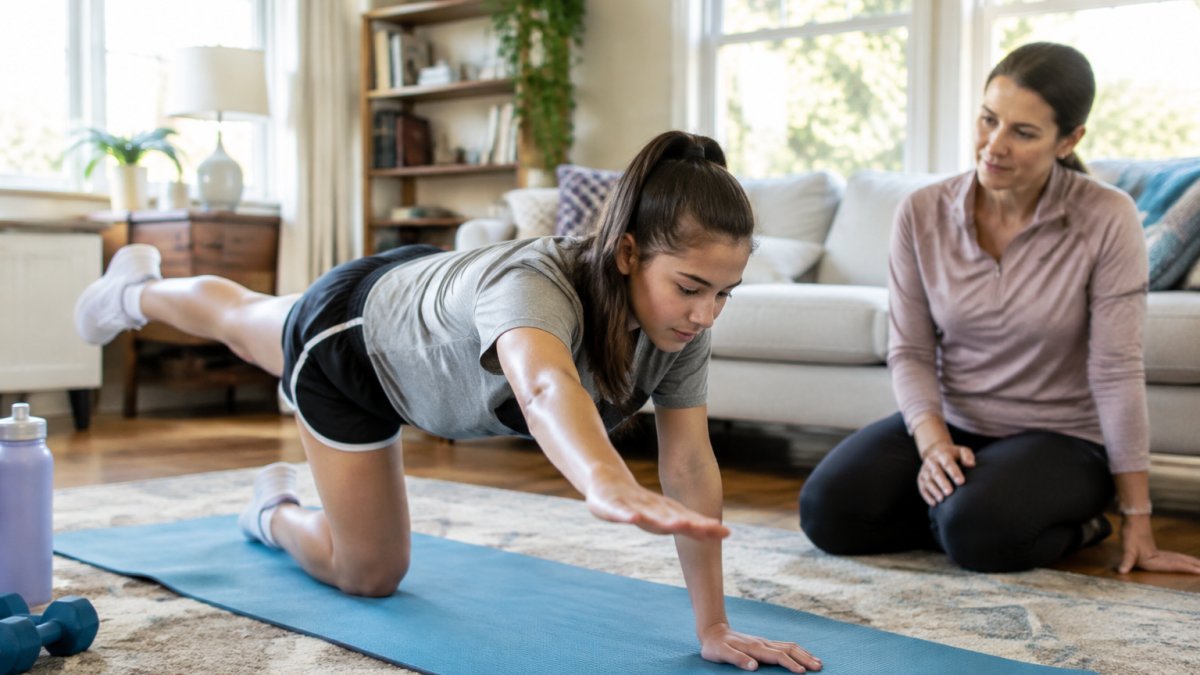
Phase 2: Gentle Movement and Core Strength
Once pain eases, gentle movement begins. Start with these: (Source: National Institute of Arthritis and Musculoskeletal and Skin Diseases)
- Pelvic tilts, lying on the back, 10 slow reps
- Bird-dog, alternating arm and leg, 8 per side
- Dead bug, 8 per side, slow and controlled
- Glute bridge, 10 reps
- Cat-cow stretch, 8 slow reps
Do these once or twice a day, and stop any exercise that brings sharp pain. Progress by adding a few reps or a second set only when the current set stays pain-free. Our list of back pain relief exercises you can do at home gives a safe starting set.
Phase 3: Sport-Specific Rebuild
When daily movement and core work are pain-free, add sport-specific drills at half speed. A soccer player might start with light jogging and passing; a gymnast with controlled non-extension shapes; a football player with stance and footwork without contact. Keep sessions short, and advance only when the prior session stays pain-free for a few sessions.
Phase 4: Return-to-Play Checks
Before full practice, the teen should pass simple checks: full pain-free range of motion, pain-free single-leg hops, pain-free resisted sprints, and pain-free cutting or sport-specific skills. A gradual return means half a practice, then a full practice, then a game, with a rest day after each step. The American College of Sports Medicine stresses gradual progression in training load to lower injury risk.
| Stage | Focus | Move On When |
|---|---|---|
| Phase 1 | Relative rest, pain control | Pain easing in daily life |
| Phase 2 | Gentle movement, core strength | Exercises pain-free |
| Phase 3 | Sport-specific drills at half speed | Drills pain-free for a few sessions |
| Phase 4 | Return-to-play checks and full practice | Each step pain-free, with rest days |
| Prevention | Training load, monitoring | Sustained full activity |
Teen-Specific Factors That Change the Plan
Growth spurts can make the spine more vulnerable to repetitive extension and rotation, so reduce extension-heavy volume during a rapid growth phase. Sport specialization and year-round play raise cumulative load, so build in rest days and a lighter week every few weeks. Sleep and recovery habits matter as much as the exercises. Watch out: a teen who returns to full practice before passing the return-to-play checks is the most common reason back pain comes back.
Returning to Sports After a Back Injury: A Step-by-Step Progression
Returning to sports after a back injury follows a gradual progression, not a single green light. Each step builds on pain-free movement at the one before it.
Here is the progression we walk families through:
- Step 1: Full pain-free range of motion in daily life
- Step 2: Core and hip strengthening with no pain
- Step 3: Sport-specific drills at half speed
- Step 4: Running drills and single-leg hops
Move to the next step only when the current one stays pain-free for a few sessions. The American College of Sports Medicine stresses gradual progression in training load to lower injury risk.
| Stage | Focus | Move On When |
|---|---|---|
| Phase 1 | Relative rest, pain control | Pain easing in daily life |
| Phase 2 | Gentle movement, core strength | Exercises pain-free |
| Progression | Sport-specific drills to full play | Each step pain-free |
| Prevention | Training load, monitoring | Sustained full activity |
When to See a Specialist for Teen Back Pain
See a specialist when back pain lasts more than a few weeks, keeps returning, or comes with any red flag. A clinical evaluation can sort a simple strain from a stress injury that needs imaging and a tailored plan.
A thorough exam checks range of motion, strength, and pain with spinal extension. Imaging may be needed when a stress fracture is suspected.
How Chiropractic Care Fits Into Sports Injury Recovery for Teen Back Pain
Chiropractic care fits into sports injury recovery for teen back pain as a gentle, non-invasive option focused on mobility and function. Chiropractic care can be considered as a gentle, non-invasive option focused on mobility and function.
Parents often ask whether chiropractic is proven for kids. If you are looking for a sports injury chiropractor in San Antonio, our sports injury care page explains what an evaluation involves. Our article on chiropractic for youth sports injury recovery goes deeper into how care supports young athletes.
Preventing Recurrence: Training Load, School, and Family Support
Preventing recurrence comes down to managing training load and keeping the whole family involved. A teen back strain that heals and then returns usually signals a load problem, not bad luck.
- Track weekly practice and game hours
- Build in rest days after heavy sessions
- Keep core strengthening going through the season
- Loop in coaches and school staff on any restrictions
The National Institute of Arthritis and Musculoskeletal and Skin Diseases notes that back pain in young people deserves attention when it limits activity. Family and school participation make the difference between a full recovery and a repeat injury.
Book a Complimentary Evaluation at Moore Chiropractic
Teen back pain from sports rarely needs to become a season-ending problem, but it does need the right eyes on it early. If your young athlete is hurting, guessing at home costs time you may not have. Moore Chiropractic offers a complimentary evaluation and consultation for new patients, and our team provides gentle chiropractic techniques and personalized care plans aimed at enhancing mobility and long-term health.
Frequently Asked Questions
Is back pain normal for a teenage athlete?
Some soreness after a hard practice can be normal, but recurring or persistent teen back pain is not something to dismiss. Low back pain in adolescent athletes is often associated with overuse, rapid training load increases, or stress reactions in the spine. If pain lasts more than a few days, wakes your child at night, or limits activity, it deserves a clinical evaluation rather than rest alone.
What are the pediatric back pain red flags that mean stop playing?
Stop sports and seek medical care if your teen has pain that persists at rest, pain that wakes them at night, numbness or weakness in the legs, bowel or bladder changes, unexplained weight loss, fever, or pain after a direct impact or fall. These pediatric back pain red flags can point to something more serious than a muscle strain and should be checked promptly by a qualified professional.
How long does it take to return to sports after a back injury?
Minor strains often improve within one to two weeks with relative rest and gentle movement. Stress injuries such as spondylolysis typically need longer, sometimes several weeks to a few months, and require a gradual return to play. Returning to sports after a back injury should follow pain-free movement first, then sport-specific drills, and finally full participation, ideally guided by a clinician.
Can chiropractic care help teen back pain from sports?
Gentle chiropractic care can be part of a broader recovery plan for some teen athletes with mechanical back pain, alongside activity modification, therapeutic exercise, and core strengthening. It is not a substitute for medical evaluation when red flags are present. Moore Chiropractic offers a complimentary evaluation and consultation for new patients to discuss whether care may be appropriate.