

Table of Contents
- What Gentle Chiropractic Care Actually Means
- Low-Force Chiropractic Techniques for Sensitive Patients
- How to Prepare for Your First Chiropractic Adjustment
- Chiropractic vs Physical Therapy for Chronic Pain
- How Gentle Adjustments Address Spinal Alignment and Nerve Function
- Common Mistakes to Avoid When Starting Chiropractic Care
- When Gentle Chiropractic Is the Right Choice
- Conclusion
Last Updated: August 10, 2026
What Gentle Chiropractic Care Actually Means
Gentle chiropractic for chronic back pain uses low-force spinal manipulation and manual therapy to address pain and improve spinal alignment without aggressive thrusting movements. Many patients with long-standing back pain fear traditional "cracking" adjustments because years of pain make the nervous system hypersensitive, making aggressive techniques counterproductive.
Gentle chiropractic isn’t watered-down care; it’s a strategic approach that prioritizes comfort while delivering measurable results for range of motion, nerve function, and inflammation reduction. Rather than forcing joints into alignment through high-velocity thrusting, gentle techniques use sustained pressure, slow mobilization, and precise positioning to encourage your body’s natural healing response. This approach is especially effective for subacute back pain (6-12 weeks) and chronic conditions where muscles have learned to guard against movement.
Many patients report that gentle techniques feel “lighter” but produce deeper relief because they don’t trigger the protective muscle contraction that aggressive adjustments sometimes cause. Your body relaxes into the adjustment rather than bracing against it.
The evidence supports this approach. Patients with chronic pain often benefit more from techniques addressing the nervous system’s role in pain perception alongside mechanical dysfunction.
Low-Force Chiropractic Techniques for Sensitive Patients
Low-force techniques are built for people whose bodies have endured years of pain, trauma, or unsuccessful treatments. These methods address the core problem: chronic back pain lives in your spine, nervous system, muscles, and movement patterns.
Flexion-Distraction and Mobilization
Flexion-distraction is highly effective for chronic back pain, particularly when disc involvement or nerve compression is present. The technique uses a specialized table that gently flexes and distracts vertebrae, creating negative pressure in the disc space and reducing nerve pressure.
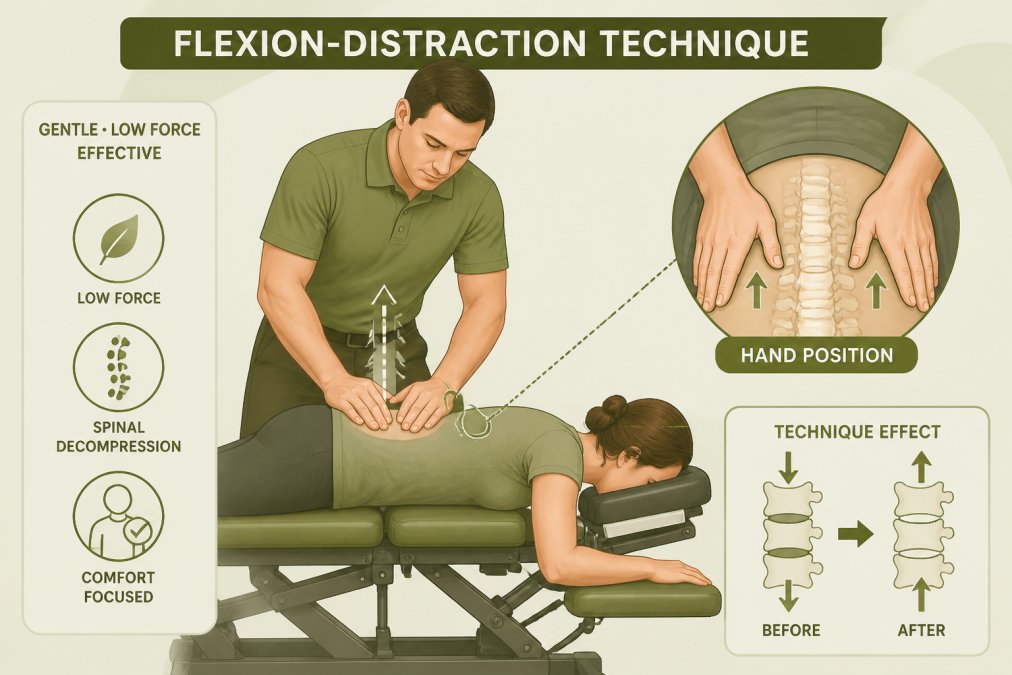
You lie face-down on a table that slowly bends and stretches your lower spine. The movement is gradual and controlled. This technique is particularly valuable for patients who’ve experienced flare-ups with aggressive adjustments.
Mobilization techniques use the chiropractor’s hands to move joints through their range of motion, gradually increasing movement as muscles relax. Think of it as guided stretching where the practitioner controls pace and pressure. Both techniques work with your body’s natural healing response rather than against it. Relief typically comes in the hours and days after treatment as inflammation reduces and movement becomes easier.
Trigger Point Therapy and Soft Tissue Work
Trigger point therapy targets muscle knots that develop when chronic pain causes muscles to tighten. Your chiropractor applies sustained pressure to these points, gradually releasing muscle contraction and restoring blood flow.
Soft tissue mobilization addresses broader muscle groups surrounding your spine through techniques like myofascial release, reducing restrictions that limit movement and contribute to pain.
The combination of trigger point therapy and soft tissue work addresses the muscular component of chronic pain that spinal adjustments alone cannot fix. Many patients find this combination produces longer-lasting relief than adjustments by themselves.
These techniques work because they invite release rather than forcing it. Your muscles relax when they feel safe, and sustained, controlled pressure communicates safety to your nervous system.
How to Prepare for Your First Chiropractic Adjustment
Walking into a chiropractic office for the first time when you’ve had chronic pain for years carries real anxiety. Proper preparation sets the stage for success.

What to Bring and Questions to Ask
Before your first appointment, gather your medical history. Bring any imaging (X-rays, MRI results) from the past few years, a list of previous treatments, and documentation of any surgeries. Write down your pain pattern: when it hurts worst, what movements help or worsen it, whether it radiates, and if time of day matters.
Prepare key questions:
- What specific techniques will you use, and why are they appropriate for my situation?
- How many visits do you typically recommend, and what should I expect from each phase?
- Will you combine chiropractic with other treatments like exercise or ergonomic changes?
- How will we measure progress?
- What activities should I avoid during treatment?
These questions help you assess whether your chiropractor takes a patient-centered approach or pushes a one-size-fits-all plan. A good chiropractor explains their reasoning and adjusts based on your response.
Setting Realistic Expectations for Results
Chronic pain lasting months or years won’t disappear in one or two visits. However, you should notice changes within the first 3-5 visits: reduced morning stiffness, easier movement in specific directions, or decreased pain during previously troublesome activities.
The timeline typically follows this pattern: initial relief from inflammation reduction (1-3 weeks), gradual restoration of mobility and strength (4-8 weeks), and long-term stability through maintenance care and home exercises (ongoing). Most patients see meaningful improvement within 4-6 weeks of consistent treatment.
A common mistake is stopping treatment as soon as pain decreases. Chronic pain often returns without follow-up care and home exercises because the underlying movement dysfunction hasn’t fully resolved. Your chiropractor should transition you toward independence, not dependence.
Chiropractic addresses mechanical dysfunction, reduces inflammation, and improves nerve function. It doesn’t cure arthritis, reverse disc degeneration, or eliminate pain from serious structural damage. A chiropractor who promises complete pain elimination or claims chiropractic replaces necessary surgery is overstating what’s realistic.
Chiropractic vs Physical Therapy for Chronic Pain
This comparison comes up frequently among people considering options for chronic back pain. The answer isn’t "one is better", they address different aspects of the problem, and many benefit from both.
Physical therapy focuses on strengthening muscles, restoring movement patterns, and teaching your body to move without pain. Chiropractic addresses joint mobility, spinal alignment, and nervous system regulation.
Here’s where they complement each other: if your spine is restricted and misaligned, exercise becomes less effective because muscles work around a mechanical problem. If muscles are weak and movement patterns are poor, spinal adjustments provide temporary relief but the problem returns.
The most effective approach combines both. Your chiropractor addresses joint-level dysfunction while your physical therapist builds strength and movement patterns that prevent recurrence. Many patients find that starting with chiropractic to restore mobility, then transitioning to physical therapy to build strength, produces the best long-term results.
| Approach | Primary Focus | Best For | Timeline |
|---|---|---|---|
| Chiropractic | Joint mobility, nerve function, inflammation | Restricted movement, acute flare-ups | 4-6 weeks for initial improvement |
| Physical Therapy | Strength, movement patterns, endurance | Muscle weakness, movement dysfunction | 6-12 weeks for measurable strength gains |
| Combined | Mobility + strength + movement quality | Most chronic pain cases | 8-12 weeks for comprehensive improvement |
How Gentle Adjustments Address Spinal Alignment and Nerve Function
Your spine protects your spinal cord and the nerves branching between vertebrae. When vertebrae shift out of alignment, they irritate these nerves, triggering pain and restricting movement. Gentle chiropractic restores proper vertebral positioning, reducing nerve irritation and allowing your nervous system to calm down.
When a nerve has been irritated for months or years, it becomes hypersensitive, even minor irritation produces significant pain. Removing that irritation allows the nerve to reset and pain response to decrease. Restricted joints don’t move smoothly, muscles tighten to protect them, and your nervous system perceives threat. Gentle mobilization restores smooth movement, muscles relax, and your nervous system receives the signal that movement is safe.
Spinal alignment also affects your proprioceptive system, your body’s awareness of where it is in space. Chronic pain disrupts this awareness, causing movement patterns that perpetuate dysfunction. Gentle adjustments help recalibrate your proprioceptive system so your body naturally moves in healthier patterns.
Gentle adjustments can be more effective than aggressive ones for chronic pain because they don’t trigger protective muscle contraction. Your nervous system relaxes into a gentle adjustment rather than bracing against it.
Common Mistakes to Avoid When Starting Chiropractic Care
Stopping too early. Pain decreases quickly with chiropractic care, often within the first few visits. Many patients interpret this as "I’m fixed" and stop treatment. What’s actually happened is inflammation has reduced, but underlying movement dysfunction hasn’t resolved. Pain returns within weeks because the root cause remains.
Skipping home exercises. Chiropractic addresses what happens on the table; home exercises address what happens in daily life. Without exercises, you return to the same movement patterns that created the problem.
Not addressing ergonomics or movement habits. If you spend eight hours a day at a desk with poor posture or lift heavy objects with bad form, you’re undoing treatment. Ask your chiropractor what changes you should make to your daily routine.
Choosing aggressive treatment over gentle. Aggressive adjustments feel more "effective" because they produce audible cracks, but they often trigger protective muscle contractions that increase pain in sensitive patients. Gentle techniques feel more subtle but produce better long-term results for chronic conditions.
Not communicating honestly about pain. If an adjustment hurts or worsens your pain, tell your chiropractor immediately. A good chiropractor adjusts their technique based on your feedback.
When Gentle Chiropractic Is the Right Choice
You’re a good candidate if your pain has lasted more than 12 weeks, you’ve tried other treatments without lasting relief, or you have sensitivity to aggressive manipulation. Gentle techniques work particularly well for conditions involving nerve irritation, disc involvement, or significant muscle guarding.
Gentle chiropractic is especially appropriate if you’re pregnant, elderly, have osteoporosis, or have had previous spinal surgery. You should be cautious about chiropractic care if you have serious structural damage requiring surgery, active infection, or certain neurological conditions.
The critical question is whether your pain pattern suggests mechanical dysfunction amenable to chiropractic care. Pain that’s reproducible, specific movements consistently trigger it, suggests mechanical dysfunction. Your chiropractor should assess this during consultation and be honest about whether chiropractic is likely to help.
Moore Chiropractic in San Antonio specializes in personalized, gentle chiropractic care for people with chronic pain who need a patient-centered approach. Our team uses a combination of gentle spinal mobilization, trigger point therapy, and soft tissue work tailored to your individual needs. We offer a complimentary evaluation and consultation so you can understand your specific condition and what realistic improvement looks like before committing to treatment.
Chronic back pain lasting years often requires a different approach than acute injuries. Gentle chiropractic for chronic back pain addresses the underlying mechanical dysfunction and nervous system sensitization that perpetuate long-standing pain. If you’re in San Antonio and considering whether chiropractic care might help, Moore Chiropractic provides personalized evaluation and comprehensive treatment designed to restore your mobility and reduce pain through evidence-based, patient-centered care. Contact us for your complimentary consultation to discuss your specific condition and discover how gentle chiropractic techniques can support your path to lasting relief.
Frequently Asked Questions
What is considered 'gentle' chiropractic care?
Gentle chiropractic care uses low-force techniques and manual therapy to address spinal alignment and nerve function without aggressive high-velocity adjustments. These methods include flexion-distraction, soft tissue mobilization, and trigger point therapy. Gentle care prioritizes patient comfort and is especially suitable for those with sensitive conditions, recent injuries, or fear of traditional spinal manipulation. Your chiropractor will assess your specific needs during a clinical assessment to determine which techniques are appropriate for your situation.
Can gentle chiropractic actually help chronic back pain that hasn't responded to other treatments?
Gentle chiropractic addresses chronic back pain by reducing inflammation, restoring range of motion, and improving biomechanics through patient-centered care. Many people find relief after trying other options because chiropractic takes a different approach, focusing on spinal alignment and nerve function rather than just symptom management. However, results vary based on your condition's cause and duration. A complimentary evaluation with a qualified chiropractor can determine whether gentle care is appropriate for your specific situation and what realistic outcomes you might expect.
How do low-force chiropractic techniques differ from traditional adjustments?
Low-force techniques use sustained pressure, gradual mobilization, and specialized equipment rather than the rapid twisting motions of traditional spinal manipulation. Methods like flexion-distraction involve a motorized table that gently stretches the spine, while soft tissue mobilization targets muscle tension around the vertebrae. These approaches reduce the risk of aggravating sensitive tissues and are especially beneficial for patients with arthritis, osteoporosis, or recent injuries. The goal is the same, improving spinal alignment and nerve function, but the method is gentler and often more comfortable.
What should I expect during my first gentle chiropractic appointment?
Your first visit typically includes a clinical assessment where the chiropractor reviews your medical history, asks about your pain patterns, and performs physical tests to evaluate your range of motion and spinal alignment. They may take X-rays or other imaging if needed. The chiropractor will explain their findings and discuss treatment options before any adjustment. If you proceed, your first gentle adjustment is usually brief and focuses on low-force techniques. Bring your insurance card and any medical records, and arrive 10-15 minutes early to complete intake forms.
This article was written using GrandRanker